

Uncategorized
Transmissible Cancer Discovered in Freshwater Fish

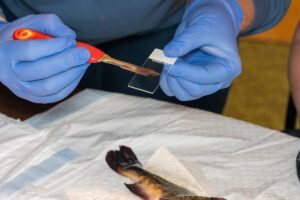
Researchers headed by a team at the University of Vermont have discovered that mysterious black skin lesions afflicting catfish in Lake Memphremagog and other New England and Canadian lakes are caused by a transmissible form of cancer, the first ever identified in a freshwater fish species. The scientists’ studies showed that the cancer cells behave more like parasites than conventional tumors, moving from fish to fish.
The discovery marks only the fourth type of transmissible cancer identified in the animal kingdom, and the first in any fish or freshwater species. Previous ones include the Tasmanian devil’s facial tumor disease, a transmissible venereal tumor in dogs, and transmissible leukemia-like diseases in clams, mussels, and other bivalve mollusks. The researchers do emphasize that the disease poses no known risk to humans. The cancer cells cannot infect or survive in another species, and the fish are safe to handle and study.
The new discovery sheds light on how cancer can spread in the wild, and raises important questions about where this cancer originated, how it will affect fish health and populations, and also how cancer works in all animals including humans.
Julie Dragon, PhD, a researcher at the UVM Cancer Center in the Larner College of Medicine, suggests that understanding this newly discovered transmissible cancer could offer new insights into cancer biology more broadly. “By studying how cancers survive and spread outside their original host, we can learn a great deal about what keeps cancers contained—and what happens when those boundaries break down,” she said. “These fish provide an opportunity to look at evolution of cancer.”
Dragon is co-lead author of the researchers’ published report in Nature, titled “Brown bullhead catfish melanoma represents a novel transmissible cancer,” in which they stated, “We found extensive genomic evidence to suggest these melanistic lesions represent a transmissible cancer, to our knowledge, the first known occurrence in a fish species and the first found in a freshwater aquatic setting.”
Since 2012, anglers and biologists have reported a striking increase in brown bullhead catfish (Ameiurus nebulosus) with raised black skin patches in the cross-border lake shared by Vermont and Quebec. By 2014, nearly one in three fish showed the dark lesions. Because brown bullhead are considered indicators of environmental quality, the researchers suspected a contaminant or pathogen linked to pollution. “At first, we thought this disease might be a virus, but that wasn’t panning out,” said Dragon.
Instead, scientists found that these lesions turned out to be melanoma, a skin cancer. “This was surprising,” Dragon said, “and we wanted to know how a bottom-dwelling fish was getting a cancer we associate with exposure to too much sunlight.” For their reported study Dragon and colleagues took what she describes as a “deep dive,” into the genetics of the cancer cells.
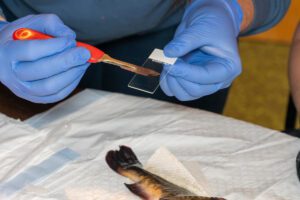
Using whole-genome sequencing, the team compared DNA from tumors and healthy tissues in affected fish. They expected to find a genetic mutation that makes the fish susceptible to having their own cells become cancerous. Instead, they found that the cancer cells were much more closely related to each other than to their host fish—the signature of a clonally transmissible cancer, in which tumor cells themselves act as infectious agents.
“Hundreds of thousands of genetic variants are shared among tumor samples but absent from host fish, vastly exceeding levels seen in conventional cancers,” the authors reported in their paper.
The research team is now working to understand how the cancer cells spread between animals. “It seems to only happen in larger fish that are of spawning age,” said study co-lead Mark Henderson, PhD, fish biologist at UVM’s Rubenstein School of Environment and Natural Resources. “Maybe some part of spawning behavior leads to the spreading of the cancer between animals.”
The study notes that pollutants or hormonal changes could weaken immune systems, making the lake’s brown bullhead fish more vulnerable to infection. Naturally occurring arsenic may also play a role. The team did find that the fish cancer cells have elevated levels of arsenic and the geographic distribution of the cancer appears to have correlation with levels of arsenic in the lakes’ surrounding soil. “Arsenic is found naturally throughout New England, and there’s really high concentrations of it in the Vermont’s Northeast Kingdom as well as up through Maine, which is where we’ve also seen evidence of this cancer,” said Henderson.
The cancer’s ecological impact remains uncertain. Some transmissible cancers are devastating—the Tasmanian devil tumor has wiped out 90% of some populations. In contrast, the dog tumor has coexisted with its hosts and has done for thousands of years. In Lake Memphremagog, heavily diseased bullhead can survive for years, but long-term population effects are still unknown.
The researchers are beginning to explore how long this cancer may have been around, and how common transmissible cancers may be. They are exploring ponds and rivers in Massachusetts to learn more about the distribution of the cancer and to see if it may have originated there. “Our contention is that maybe it’s not as rare as everyone thinks. We’re just not seeing it,” said Dragon. “In the case of transmissible cancers, it may be that we don’t see many simply because we aren’t looking for them.”
In their paper the team concluded, “Although we cannot rule out a role for conventional pathogens in the original emergence or ecological transmission of this disease, the genomic evidence presented here overwhelmingly supports a transmissible cancer in which the tumor cells themselves act as the infectious entity.”
The post Transmissible Cancer Discovered in Freshwater Fish appeared first on GEN – Genetic Engineering and Biotechnology News.



Hosted by Drug Discovery World and supported by Sartorius and BioIVT, this webinar will explore the opportunities and challenges that exist within cancer research drug discovery and development.
You will hear from Dr Sudha Rao, Chief Scientific Officer of Kazia Therapeutics, Karol Budzik, PhD, Business Development Associate at Vyriad Therapeutics and Lars van der Veen, Chief Scientific Officer at iOnctura.
Presentations will cover how cancer treatments have shifted towards reprogramming the biology driving tumour growth, immune escape and treatment resistance, the trajectory that in vivo CAR-T treatments are taking, and how challenging tumours burdened by stroma and immune-mediated resistance can be tackled.
Q&A with the speakers follows the presentations.
The post New webinar: Tackling drug discovery challenges in cancer research appeared first on Drug Discovery World (DDW).
Amid the rise of psychedelics in the mental health space, researchers have begun to explore psilocybin as a treatment for chemotherapy-induced peripheral neuropathy.
Uncategorized
New Spectrometry Technique Could Aid Formulation Development
New Spectrometry Technique Could Aid Formulation Development
A new technique combining two forms of spectrometry could help biopharmaceutical companies improve their choice of formulation buffer for antibody manufacturing by revealing how molecular forms and three-dimensional shapes of complex biologics respond to their environment. That’s the view of Christian Bleiholder, PhD, a professor at Florida State University who helped develop the technique.
According to Bleiholder, what happens structurally when a complex biological molecule, such as an antibody or viral spike protein, binds to its target is currently poorly understood.
“This is where [this approach] can help with the bioprocessing and formulation,” he says, as structural changes “can affect the lifespan [of the product] and lead to issues, such as aggregation.”
Because antibodies are complex, existing techniques tend to be powerful at different levels of complexity, he explains. Mass spectrometry is particularly powerful for distinguishing molecular composition, while structural approaches such as X-ray crystallography and cryo-electron microscopy can provide high-resolution structural information.
The challenge is understanding the link between these things within a heterogeneous sample, he says.
To overcome this, Bleiholder and his team worked with Bruker Daltonics to develop Tandem-Trapped Ion Mobility Spectrometry (Tandem-TIMS). This combines tandem ion mobility spectrometry with tandem mass spectrometry to disentangle three overlapping layers of molecular complexity: molecular form, three-dimensional shape, and binding or assembly state, he says.
He explains that, if the proteins have different structures, they can be characterized with tandem ion mobility spectrometry, and then mass spectrometry can be used to look at their molecular forms and binding states.
Going forward, Bleiholder hopes the technique can be used for formulation development but also earlier, during drug discovery of new products, such as multi-specific antibodies, to determine which molecular states are important and how those change when a biologic engages its target. He also plans to look at automating the technique.
Bleiholder spoke about using Tandem-TIMS at the Bioprocessing Summit in Boston earlier this year.
The post New Spectrometry Technique Could Aid Formulation Development appeared first on GEN – Genetic Engineering and Biotechnology News.


Novartis projects slowed growth, pins hopes on billions in pipeline potential

Actinogen’s sole drug fails pivotal Alzheimer’s study, sinking stock 80%

Regeneron racks up another first as FDA greenlights generalized myasthenia gravis RNA drug

Sanofi secures first FDA approval to treat neurological symptoms in rare metabolic disease

The untapped potential of drug repurposing

AbbVie grooves with DISCO’s solid tumor tech in up to $2.5B licensing deal
-

 Uncategorized8 months ago
Novartis buys Synnovation’s PI3Kα inhibitors for $3 billion
-
Endpoints News8 months ago
Novartis to pay $2B upfront to take next-gen PI3Kα inhibitor from Synnovation
-

 Uncategorized7 months ago
Optical Pooled CRISPR Screen Reveals Regulators of NF-κB Dynamics in Human Cells
-
Uncategorized6 months ago
Relay’s PI3Kα inhibitor clears efficacy bar in Phase 2 vascular anomalies study
-
Uncategorized5 months ago
Hybrid solid−liquid optics enable scalable, high-resolution light-sheet microscopy across diverse immersion media
-
Fierce Biotech8 months ago
Scientists turn pig semen extract into eye drops that kill cancer in mice
-
Nature Biotechnology8 months ago
Sustained nitric oxide production by engineered E. coli remodels the tumor microenvironment and potentiates immunotherapy
-
Nature Biotechnology8 months ago
Mapping cis-regulatory mutations at scale in sorghum enables modulation of gene expression
 Scan to Read