
Uncategorized
Top 10 Organoid Companies

The past year marked a proverbial inflection point for organoid models designed to uncover biological insights previously unattainable through traditional cell culture experiments or animal models.
The FDA in October approved the first-ever investigational new drug (IND) submission supported solely through human vascularized organoid-based combination studies, without relying on traditional animal efficacy proof-of-concept (POC) testing. The IND application by SillaJen enabled the South Korea-based developer of oncolytic virus immunotherapeutics to begin clinical trials for a combination therapy consisting of tislelizumab or paclitaxel and BAL0891, a dual inhibitor of threonine tyrosine kinase (TTK) and polo-like kinase 1 (PLK).
SillaJen’s combo therapy incorporating BAL0891 is being evaluated in a Phase I trial (NCT05768932) whose primary completion date is estimated at December 24. SillaJen’s IND included preclinical efficacy data generated through the vascularized tumor immune microenvironment model (vTIME) developed by Qureator.
The vTIME platform and SillaJen’s trial are early examples of the shift away from animal testing toward new approach methodologies (NAMs), which the FDA sought to advance through the FDA Modernization Act 2.0, enacted in 2022. The measure removed the animal testing requirement for new FDA-regulated products that was imposed through the Federal Food, Drug, and Cosmetics Act of 1938.
“By leveraging AI-based computational modeling, human organ model-based lab testing, and real-world human data, we can get safer treatments to patients faster and more reliably, while also reducing R&D costs and drug prices,” FDA Commissioner Martin A. Makary, MD, stated last year. “It is a win-win for public health and ethics.”
The changing regulatory climate is expected to nearly triple the size of the global organoids market over the next five years, from $1.20 billion last year and a projected $1.42 billion this year to $3.29 billion in 2031—a compound annual growth rate (CAGR) of 18.31%, according to a Mordor Intelligence report released in February. The report listed market share leaders in several categories, including:
- Source: Stem-cell-derived models (58.43%)
- Organ type: Intestinal cultures (28.65%)
- Application: Drug discovery and screening (46.54%)
- End users: Biopharma companies (55.63%)
- Technology: Scaffold-based 3D culture (32.65%)
Given their growing role in drug discovery and prospects for future growth, GEN has compiled its first-ever A-List of organoid companies.
Public companies are ranked by their combined revenues for 2025—or if not available, by their combined revenues for the first nine months of 2025 and fourth quarter of 2024—as disclosed in regulatory filings, including sales of products or services, as well as revenue from collaborations and R&D activity.
The top five public companies are ranked below. Just outside the top five at #6 was Takara Bio, whose reagents business includes organoids. Reagents generated a combined ¥31.211 billion ($197.19 million) in net sales between January and March 2025, the final quarter of its 2025 fiscal year, and April-December 2025, the first three quarters of its FY 2026. Also outside the top five was Tecan Group, whose Life Sciences Business racked up CHF 377.1 million (about $483 million) in 2025 revenue. Two Chinese companies, ACRObiosystems and Sino Biological, reported smaller revenue figures.
Private companies are ranked by the total capital they have raised, as disclosed by the companies themselves, either in press statements or in responses to GEN queries verifying figures compiled by other sources. Companies that failed to respond at deadline have been ranked according to their most recently published figures for total capital raised.
The top five private organoid companies are ranked below. Private companies placing between #6 and #10 in GEN’s rankings include Pandorum Technologies (a reported $43.7 million in total capital raised), Parallel Bio ($30 million), Mimetas (a reported $29.4 million), 28bio ($24 million), and Curi Bio (a reported $20.1 million).
28bio and publicly traded Corning co-sponsored GEN’s recent Spotlight on Organoids, a virtual summit exploring how, from drug developers to universities to research institutions, investigators are increasingly using organoid models. This inaugural GEN Spotlight is available to watch on demand; registration is free.
Not included among the ranked private companies is Crown Bioscience. While the San Diego provider of translational oncology services—including the organoid panel screening platform OrganoidXplore—has raised a reported $108 million in total capital, Crown announced plans last November to be sold by Sunnyvale, CA-based JSR Life Sciences for $204 million to Hangzhou, China-based Adicon Holdings, a portfolio company of The Carlyle Group.
Top 5 Public Companies |
|
1. Thermo Fisher Scientific (Life Sciences Solutions segment) Revenue: $10.374 billion in 2025 Thermo Fisher Scientific’s Life Sciences Solutions segment includes sales from products used in developing organoids, such as OncoPro Tumoroid Cell Lines to support tumoroid development, StemFlex Medium for robust expansion of pluripotent stem cells, and Geltrex Flex matrix for the growth of a variety of cells in 3D cell cultures. In December, Thermo Fisher and AIM Biotech announced a partnership to develop standardized, reliable microphysiological systems (MPSs), focused initially on creating vascularized tumoroid models that the companies said could revolutionize cancer research and immunotherapy development. AIM Biotech contributed its organiX MPS for organoids and biopsies, as well as its VasQ Kit, all-in-one vascularization solution, and technical expertise, while Thermo Fisher provided well-characterized patient-derived tumoroid models, fit-for-purpose OncoPro Tumoroid Culture Medium, and supporting reagents. |
|
2. Merck KGaA, Darmstadt, Germany (Life Science business) Revenue: €8.98 billion ($10.348 billion) in 2025 Merck KGaA, Darmstadt, Germany, aims to build a leading presence in organoids through foundational technology, a growing portfolio of patient-derived models, and scalable commercial capabilities. In January 2025, the company announced its acquisition of organoid development pioneer HUB Organoids Holding, based in Utrecht, The Netherlands. By integrating HUB’s patient-derived organoid technology with its existing cell culture expertise, Merck KGaA envisioned enhancing its value to researchers seeking to apply 3D cell culture and next-generation biology to understand drug response earlier in development. In October, Merck KGaA launched a partnership with Promega to develop assays capable of tracking cellular activity in real time using a reporter system within organoids, allowing for testing in models that are physiologically more relevant than traditional two-dimensional models. |
|
3. Danaher (Life Sciences segment) Revenue: $7.334 billion in2025 In a December 3 post on its blog, Danaher tallied eight companies within its family of operating companies as being involved in developing organoids: Abcam, Beckman Coulter (non-diagnostic business), Genedata, IDBS, Leica Microsystems, Molecular Devices, Phenomenex, and SCIEX. The eight offer a comprehensive suite of products and technologies designed to support every stage of organoid development, from sample preparation to advanced data analysis. In December, researchers at Cincinnati Children’s Hospital Medical Center’s Center for Stem Cell and Organoid Medicine (CuSTOM), Molecular Devices, and other partners published a study detailing a new human liver organoid microarray developed by the hospital and Roche—a study co-funded by Danaher, Roche, and the Farmer Family Foundation. CuSTOM and Danaher launched their organoid development partnership in 2024. |
|
4. Charles River Laboratories (Discovery and Safety Assessment segment) Revenue: $2.403 billion in 2025 1 “From models to living systems, next-generation organoids are on the rise,” Charles River Laboratories declared in a December 4 post on its Eureka blog. “As drug discovery and development accelerate the adoption of NAMs, organoids themselves are entering a transformative era,” added Tània Martiáñez Canales, PhD, senior scientist, and Ludovico Buti, PhD, senior research leader. Immune and vascular-competent tumor organoids now capture the full complexity of the tumor microenvironment, while recent liver organoid models now approach the quality of transplant-grade tissues by exhibiting complete metabolic zonation, recapitulating the three liver’s metabolic zones, and even organ-specific vasculature. In November, Charles River committed to “evaluating opportunities to enhance its scientific capabilities” in NAMs while refining its portfolio to maximize financial performance and divest underperforming or non-core assets. |
|
5. Corning (Life Sciences segment) Revenue: $972 million in 2025 Corning offerings for organoid development include a software extension enabling Corning Cell Counter® operators to capture rapid data of 3D cell cultures based on the structure’s morphology, to the company’s Corning® Matrigel® Matrix, a solubilized basement membrane preparation used as a scaffold option to support cell expansion in organoid cultures, and Matrigel Matrix 3D plates. Matrigel and a Corning 96-well round-bottom ultra-low adhesion plate were among supplies from numerous companies used by researchers at Bernhard Nocht Institute for Tropical Medicine in Hamburg, Germany, in creating a West Nile virus encephalitis model using human cerebral organoids generated with male induced pluripotent stem cells—an effort detailed in a paper published March 7 in Nature Communications. |
|
1 2025 revenue consists of the 12 months ending December 27, 2025 |
Top 5 Private Companies |
|
1. Emulate Total Capital Raised: $250 million Emulate partnered with FujiFilm Cellular Dynamics in November to launch the Emulate Brain-Chip R1, a first-in-class isogenic model of the neurovascular unit designed to offer researchers a new platform for studying drug transport across the blood-brain barrier, as well as investigating mechanisms of neuroinflammation. Brain-Chip R1 integrates FujiFilm’s iCell® products co-cultured with Emulate’s induced Brain Microvascular Endothelial Cells. In June, Emulate commercially introduced the AVA |
|
2. Prellis Biologics Total Capital Raised: “More than” $88 million Prellis Biologics has combined its EXIS |
|
3. InSphero Total Capital Raised: $63.5 million 1 Swiss-based InSphero, in February, joined PharmaNest to launch a translational fibrosis partnership of undisclosed value, through which the companies will apply machine learning tools in combination with human preclinical models to decipher complex pathological phenotypes toward the identification of effective therapies. The collaboration combines InSphero’s advanced 3D spheroid models with PharmaNest’s high-resolution, single-fiber digital pathology, with the aim of enabling AI-assisted, precise phenotyping of fibrosis severity and remodeling for liver fibrosis in metabolic dysfunction-associated steatohepatitis (MASH) and other fibrotic 3D in-vitro models. Also in February, InSphero completed its acquisition for an undisclosed price of Doppl and its Sun Bioscience Gri3D® organoid culture platform. “For our customers, this acquisition means access to an even broader, more integrated portfolio of scalable 3D cell culture plates and organoid technologies designed to work seamlessly together,” InSphero CEO and co-founder Jan Lichtenberg, PhD, stated on LinkedIn. |
|
4. CN Bio Total Capital Raised: $60 million CN Bio isn’t an organoid company per se, but it told GEN its organ-on-a-chip (OOC) technology is positioned to improve the human accuracy and predictivity of organoid workflows. CN Bio recommends supplementing organoids with OOC cultures designed to represent 3D tissues with more human-relevant spatial organization: “Supplementing organoid use with OOC provides the means to further advance workflows by unlocking the ability to detect deeper mechanistic insights, more complex and latent effects that may otherwise be missed,” Emily Richardson, PhD, a lead scientist on CN Bio’s R&D team, wrote on the company’s blog. In October, CN Bio launched PhysioMimix® Core, an all-in-one OOC microphysiological system (MPS) designed to be the first OOC solution to deliver validated performance across single-organ, multi-organ, and higher-throughput configurations. |
|
5. Inventia Life Science Total Capital Raised: AU$65 million ($46.5 million) Inventia Life Science’s RASTRUM |
|
1 Figure published by PitchBook. At deadline, InSphero had not responded to GEN queries seeking to confirm the total capital raised figure. |
 Emulation System, a self-contained instrument designed to culture, incubate, and image up to 96 individual organ-chip samples or “Emulations” in a single run—as well as to deliver in vivo-level insights faster than animal models while cutting consumable costs fourfold and in-lab labor by half compared to current generation technologies.
The post Top 10 Organoid Companies appeared first on GEN – Genetic Engineering and Biotechnology News.

You know when you are at the eye doctor getting an updated prescription, and suddenly the world snaps into sharper focus? Physicists at the University of California (UC), Berkeley, have now done something similar for electron microscopy. By introducing phase contrast into a cryo‑electron microscope, they have delivered dramatically sharper images of some of biology’s smallest and most elusive proteins.
The advance comes from a new laser phase plate (LPP), described in the paper “Laser phase plate improves structure determination of small proteins by cryo‑EM,” which was published recently in Science. Led by physicist Holger Mueller, PhD, of UC Berkeley and Lawrence Berkeley National Laboratory, the team demonstrated that a laser‑driven phase plate can overcome one of cryo‑EM’s most persistent limitations: poor contrast for small proteins.
Cryo‑EM has transformed structural biology over the past decade, earning a Nobel Prize in 2017 for enabling high‑resolution structures without crystallization. But despite its impact, the technique still struggles with proteins below ~70 kilodaltons—a size range that includes about 90% of the human proteome. “Because of signal-to-noise limitations, the majority of human and animal proteins are too small to be analyzed by these methods [cryo-EM and cryoelectron tomography]. The increase in signal-to-noise ratio provided by this laser phase plate is expected to overcome these important limitations.”
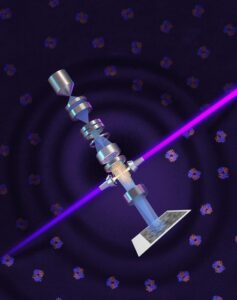
The new LPP begins to address that problem. The LPP uses an intense, continuous‑wave laser to shift the phase of the electron beam itself. This produces true phase contrast without dimming or destabilizing the beam. Mueller described the laser focus as “75 kilowatts focused to a few microns… That’s more powerful than what you use for welding. It has more power than a military laser. It builds up the brightest continuous laser focus ever.”
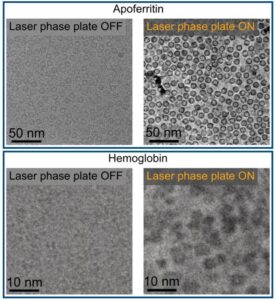
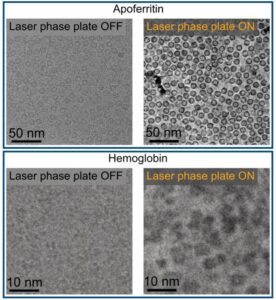
Installed in a custom Thermo Fisher Titan Krios, the LPP immediately improved the clarity and resolvability of small proteins, including hemoglobin, which sits at the lower limit of what today’s cryo‑EM instruments can handle. As the authors wrote in the abstract: “Here, we show that the laser phase plate (LPP)… enhances the resolution in single-particle reconstruction of small proteins by improving specimen-motion correction, recovery of information from the early frames, as well as particle visualization, 3D classification, and alignment.”
These improvements were achieved using standard defocus ranges and reconstruction workflows. “For the most challenging cases—small particles, bad specimens—the laser produces a very considerable advantage,” Mueller said.
The impact extends beyond single‑particle analysis. Cryo‑electron tomography (cryo‑ET), which assembles multiple angular views of a molecule or protein into a three-dimensional image, stands to benefit even more. “With cryo-ET, we’re looking at small, very complicated cellular material that’s incredibly crowded inside the cell,” said Bridget Carragher, PhD, founding technical director of imaging at Biohub. “It’s like a forest of trees, and you’re trying to find one leaf on one tree in there. Cryo-ET needs a dramatic step forward in contrast, so we can start to see what’s going on inside the cell. That’s what the laser phase plate promises to give us.”
Biohub is developing a dual‑laser version of the system, designed to reduce component wear and minimize aberrations. Meanwhile, Mueller’s team is pushing toward imaging proteins as small as 17 kilodaltons, a threshold that would open access to vast regions of the human proteome previously invisible to cryo‑EM.
“This technology is a step function change for biology,” said Stephani Otte, PhD, Biohub’s vice president of imaging science. “What was once invisible will become visible—and that changes everything about how we understand disease.”
“The bottom line is, if you have a large protein and a really good sample—a fresh one or one frozen without bubbles, for example—you may not need the phase plate to get a single, high-quality image. But for a small protein and a bad sample, laser-on is best,” Mueller said. “This could fill an enormous gap in our knowledge of protein structures that can’t be crystallized or are too small for today’s cryo-EM. And it will be revolutionary for cryo-ET.”
The post Laser‑Driven Phase Contrast Enhances Cryo‑EM Resolution of Small Proteins appeared first on GEN – Genetic Engineering and Biotechnology News.
Uncategorized
STAT+: Updated: Tracking RFK Jr.’s promises to remake health in America
Updated June 11, 2026
WASHINGTON — A pledge to “Make America Healthy Again” earned Robert F. Kennedy Jr. his job atop U.S. health agencies a year and some change ago. He’s now had the opportunity to turn his words into action, with mixed results.
“All one needs” to prove the health secretary’s attentiveness is to “review my unprecedented list of accomplishments on a wide range of issues, all of which I drove,” Kennedy posted on X on Wednesday in response to a journalist.

Updated June 11, 2026
WASHINGTON — A pledge to “Make America Healthy Again” earned Robert F. Kennedy Jr. his job atop U.S. health agencies a year and some change ago. He’s now had the opportunity to turn his words into action, with mixed results.
“All one needs” to prove the health secretary’s attentiveness is to “review my unprecedented list of accomplishments on a wide range of issues, all of which I drove,” Kennedy posted on X on Wednesday in response to a journalist.

Can any of the new obesity medications in development stand out from the pack? Which company just broke records with its IPO? And will the Food and Drug Administration allow greater access to experimental peptides?
We discuss all that and more on this week’s episode of “The Readout LOUD,” STAT’s biotech podcast.


Illinois’ financial crisis could bring the state to a halt
The final 6 ‘Game of Thrones’ episodes might feel like a full season
New Season 8 Walking Dead trailer flashes forward in time
Mod turns ‘Counter-Strike’ into a ‘Tekken’ clone with fighting chickens
Meet Superman’s grandfather in new trailer for Krypton
Disney’s live-action Aladdin finally finds its stars

Laser‑Driven Phase Contrast Enhances Cryo‑EM Resolution of Small Proteins

STAT+: Updated: Tracking RFK Jr.’s promises to remake health in America

An obesity drug deep-dive, and peptides move mainstream

RFK Jr. claims his calendar is publicly available. We’ve been trying to get it for a year

Nonprofit buys experimental cancer drug to maintain patient access
Potential Cocaine Addiction Targets Identified Through Genetic Mapping in Rats
Illinois’ financial crisis could bring the state to a halt
The final 6 ‘Game of Thrones’ episodes might feel like a full season
New Season 8 Walking Dead trailer flashes forward in time
Mod turns ‘Counter-Strike’ into a ‘Tekken’ clone with fighting chickens
Meet Superman’s grandfather in new trailer for Krypton
Disney’s live-action Aladdin finally finds its stars
-
 Uncategorized9 years ago
These ’90s fashion trends are making a comeback in 2017
-
Uncategorized9 years ago
According to Dior Couture, this taboo fashion accessory is back
-
Endpoints News3 months ago
Novartis to pay $2B upfront to take next-gen PI3Kα inhibitor from Synnovation
-
Uncategorized9 years ago
Phillies’ Aaron Altherr makes mind-boggling barehanded play
-
Uncategorized9 years ago
Uber and Lyft are finally available in all of New York State
-
Contributors9 years ago
The final 6 ‘Game of Thrones’ episodes might feel like a full season
-
Uncategorized9 years ago
Steph Curry finally got the contract he deserves from the Warriors
-
Uncategorized9 years ago
The old and New Edition cast comes together to perform