

Uncategorized
Spatial Biology

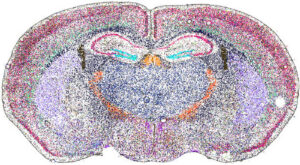
Spatial biology is a rapidly advancing discipline that examines biological molecules (such as DNA, RNA, and proteins) within their native locations in tissues. This approach offers critical insight into how cancer and immune cells interact within the tumor microenvironment.
Beginning in the 20th century, techniques such as immunohistochemistry and in situ hybridization allowed researchers to localize proteins and nucleic acid sequences directly in tissue samples. However, these analyses were typically limited to a single marker at a time. More recently, advances in high-throughput sequencing and mass spectrometry enable the simultaneous analysis of hundreds, or even thousands, of molecules while preserving spatial context. To explore the future of spatial biology, we spoke with four companies pioneering these technologies.
Spatial transcriptomics
The transcriptome is the complete collection of RNA produced in a cell or tissue at a given time. It reflects active gene expression, which varies with disease state and environmental conditions. Understanding the transcriptome is therefore crucial for studying cancer biology and treatment response.
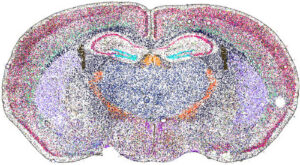
Pratheesh Sathyan, PhD, head of AMR oncology at Illumina, says that the company plans to roll out a new spatial transcriptomics platform for commercial release in 2026. He describes several advantages of spatial transcriptomics.
“Immune cells are an important part of our defense against cancer. And spatial approaches help to understand how immune cells interact with the tumor,” he says. “With spatial transcriptomics, you are maintaining the true habitat of the tissue, and that helps us with better diagnostics and better precision therapy.”
Sathyan cites pancreatic cancer as an example. “In pancreatic cancer, spatial technology has shown these little regions of protected cancer cells that allow for the progression of the disease. Understanding these areas is especially important for difficult-to-treat tumors like pancreatic cancer, where the biology is very complex.”
The term “spatial transcriptomics” is about 10 years old, notes Darren Segale, PhD, senior director of scientific research at Illumina. He recalls how Nature Methods named spatially resolved transcriptomics as its Method of the Year for 2020.1
Since then, a great deal of progress has been made in the field. Segale notes that Illumina’s platform will enable sampling of more than seven square centimeters of tissue. “This allows you to look at large bits of tumor microenvironments. More than other products available today,” he says.
Another key feature of the upcoming product is whole transcriptome coverage. “Many spatial transcriptomics platforms look at panels of typically 5,000 unique transcripts,” notes Segale. “In contrast, we are seeing 30,000 to 40,000 unique RNA transcripts per sample. It is completely unbiased and hypothesis-free. There is a real richness of information that we are seeing.” Finally, the platform will enable 1-micron spatial resolution, allowing researchers to see key surface features on the cellular level.
As part of the workflow, the tissue will undergo standard hematoxylin and eosin (H&E) staining and imaging. The spatial assay can then be performed on the bench with any Illumina sequencer. Secondary analysis is accomplished with Illumina’s DRAGEN software.
Sathyan highlights Illumina’s workshop at the 2025 Advances in Genome Biology and Technology (AGBT) conference, during which researchers from St. Jude’s Children’s Research Hospital shared data from the new platform. The research involved advanced prostate cancer.
“Using our spatial transcriptomics platform, they were able to find biomarkers that were not included in other targeted approaches,” says Sathyan. “This improved transcript coverage allowed for the analysis of rare cell types that were correlated with disease states.”
Illumina is applying its new platform to colorectal cancers, prostate cancer, and gliomas. The company presented additional breast cancer results at the 2026 AGBT conference.
“The information from our new platform will allow us to differentiate different cell types from one another and even identify new markers and new subtypes,” says Segale. “This is important because much of the cellular structure of the human body still has not been mapped, including organs and various tissues.”
They note that Illumina’s spatial transcriptomics platform is the company’s first in this product category. “We are launching this as part of a multi-omics approach in 2026 to understand cancer biology better. This will include single-cell, spatial, methylome, and proteomics analysis,” notes Sathyan.
Shifting toward the clinic
About one in every 20 people in the United States is living with Barrett’s esophagus, a condition caused by long-term exposure to stomach acid that changes the lining of the esophagus, notes Castle Biosciences’ vice president of research & development, Rebecca Critchley-Thorne, PhD. “While most people with this condition will never develop esophageal cancer, a small percentage of them do, even after appearing low risk on routine tissue examination,” she notes.
Traditional surveillance for Barrett’s esophagus relies on periodic endoscopies, followed by manual microscopic review of biopsies. “Unfortunately, this approach does not reliably distinguish patients who will remain stable from those who will progress to esophageal cancer,” says Critchley-Thorne.
Castle Biosciences’s TissueCypher spatial proteomics platform helps address this gap by identifying high-risk biological signals that may be present before cancer develops. “Measuring proteins within their spatial context in tissue makes it possible to detect subtle, complex patterns of disease biology that cannot be captured through traditional microscopy or bulk molecular tests alone,” notes Critchley-Thorne.
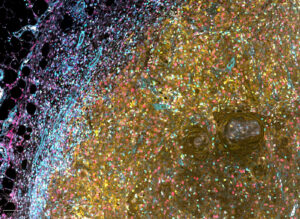
The TissueCypher test employs multiplex immunofluorescence, which utilizes antibodies labeled with fluorophores to simultaneously detect multiple markers. The patient’s tissue is labeled with fluorescent tags for nine protein biomarkers and then digitally imaged. These nine protein biomarkers are associated with key pathways in the neoplastic progression to esophageal adenocarcinoma—including tumor suppression, cell cycle control, angiogenesis, and immune cell infiltration.
The platform uses AI-driven recognition to identify relevant Barrett’s tissue and remove artifacts in tissue sections or slide mounting media. This is followed by image analysis to assess how proteins and cells are organized and interacting within the tissue.
Ultimately, the spatially resolved measurements are combined into a fixed algorithm that generates a risk score, placing patients into risk categories (high, intermediate, or low), and estimating the probability of disease progression to esophageal cancer over five years. Castle delivered more than 39,000 test reports in 2025.
Rather than replacing pathology, the TissueCypher test is designed to complement it by providing biological insight beyond what microscopic review can capture, stresses Critchley-Thorne.
Importantly, the early identification of at-risk patients creates the opportunity to intervene early with preventative treatments and more routine endoscopies. “By reducing the chance that high-risk patients progress undetected, this approach has the potential to prevent progression to esophageal cancer.”
Like Castle Biosciences, Discovery Life Sciences also offers multiplex immunofluorescence services, says Anna Juncker-Jensen, PhD, vice president of scientific affairs.
The company’s technology comprises two key instruments: the Akoya PhenoImager HT enables the rapid, high-throughput analysis of up to eight markers, while the Lunaphore COMET provides comprehensive, high-resolution profiling of up to 40 markers, including both RNA and protein.
“Both platforms offer a variety of pre-characterized panels that enable the identification of distinct immune cell populations and a characterization of the immune landscape,” she says.
Juncker-Jensen highlights the company’s expertise in building validated, multiplexed panels customized for specific research projects. “These services are increasingly important tools for our biotech and pharma clients in the search for novel prognostic and predictive biomarkers for personalized cancer therapy. We also support regulatory-compliant workflows and quantitative endpoints for clinical trials.”
Discovery’s multiplexed panels enable analysis of spatial distribution patterns within the tumor microenvironment—such as the localization of lymphocytes, myeloid cells, fibroblasts, and vessels. They also elucidate key pathways in cancer progression, including changes in the migratory and invasive properties of cells, says Juncker-Jensen.
Ultimately, Critchley-Thorne envisions that multiplexed immunofluorescence platforms will increasingly be applied in medicine. “This detailed tissue information moves care toward more personalized, biology-driven decisions that can ultimately benefit patients across a range of diseases.”
Bringing in new omics
Mike Easterling, PhD, vice president of MALDI Imaging at Bruker Daltonics, stresses that he is interested in more than just RNA and proteins.
“We often hear multi-omics defined as transcriptomics and proteomics. That leaves critical biochemical layers unexplored, and this is where mass spectrometry contributes. We integrate metabolomics, glycomics, and lipidomics because these molecular classes are responsible for disease mechanisms that transcriptomics alone cannot capture.”
“Say you need to co-localize five transcripts, seven proteins, and several glycans and lipids within the same tissue region, organized by their spatial relationship to one another. That multi-omic biomarker composite may define a disease state much more precisely than any single layer. Our platforms support exactly that kind of investigation.”
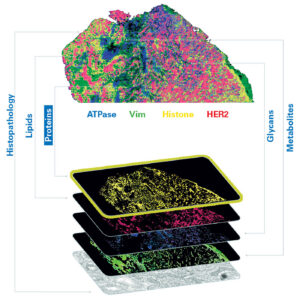
Bruker uses matrix-assisted laser desorption/ionization (MALDI) mass spectrometry as the foundation of its multi-omics approach.
“Mass spectrometry is inherently multiplexed in a way that antibody-based approaches aren’t. A single acquisition can simultaneously detect hundreds of lipid species, glycans, and metabolites across a tissue section without the need for target-specific labels. That is a fundamental advantage for unbiased discovery.”
Easterling emphasizes that Bruker’s approach is an ideal way to capture information about post-translational modifications (PTMs). Such information can be challenging to obtain reliably with antibody-based workflows, he adds.
PTMs, particularly glycosylation, are directly implicated in a host of processes like immune evasion, tumor progression, and metastasis, he notes.
“Given what we know, glycans are among the most structurally complex PTMs, exhibiting enormous diversity in composition. Unlike proteins, glycan structures are not directly encoded by the genome, making them difficult to probe with targeted assays. Mass spectrometry offers a way to profile this complexity directly from tissue.”
Easterling recounts a collaboration with Stanford University and the Medical University of South Carolina to spatially localize glycans in different tissues. This information was then combined with spatial transcriptomics and proteomics layers to analyze gliomas, a lethal cancer with very limited treatment options. Ultimately, the glycomics information emerged as the strongest classifier of tumor grade across all three omics layers.
Bruker is also collaborating with the Medical University of South Carolina to investigate how PTMs are distributed throughout the extracellular matrix using MALDI imaging. “Research usually focuses on the cell as the fundamental unit of disease biology, but the extracellular matrix is increasingly recognized as a critical regulator of a number of processes related to tumor progression,” he explains.
Spatial proteomics and transcriptomics are often quite expensive. In contrast, Easterling stresses the cost-effectiveness of Bruker’s MALDI-based techniques. With MALDI imaging, he notes that the resolution typically ranges from five to 20 microns. Running at a higher resolution (five microns) typically takes longer and increases costs and laboratory time.
“In discovery, your goal is comprehensive molecular characterization. Running at five-micron resolution provides the spatial detail needed to resolve individual cell populations. With smaller cohort sizes, longer acquisition times are acceptable.”
“But on the translational side, you typically know what you’re looking for. Operating at 10 to 20 microns significantly reduces acquisition time and cost per sample while still providing the spatial acuity required for clinically relevant readouts,” he says.
Reference
1. Method of the year 2020: spatially resolved transcriptomics. Nat Methods. 2021;18(1):1. doi:10.1038/s41592-020-01042-x.
The post Spatial Biology appeared first on GEN – Genetic Engineering and Biotechnology News.


Hosted by Drug Discovery World and supported by Sartorius and BioIVT, this webinar will explore the opportunities and challenges that exist within cancer research drug discovery and development.
You will hear from Dr Sudha Rao, Chief Scientific Officer of Kazia Therapeutics, Karol Budzik, PhD, Business Development Associate at Vyriad Therapeutics and Lars van der Veen, Chief Scientific Officer at iOnctura.
Presentations will cover how cancer treatments have shifted towards reprogramming the biology driving tumour growth, immune escape and treatment resistance, the trajectory that in vivo CAR-T treatments are taking, and how challenging tumours burdened by stroma and immune-mediated resistance can be tackled.
Q&A with the speakers follows the presentations.
The post New webinar: Tackling drug discovery challenges in cancer research appeared first on Drug Discovery World (DDW).
Amid the rise of psychedelics in the mental health space, researchers have begun to explore psilocybin as a treatment for chemotherapy-induced peripheral neuropathy.
Uncategorized
New Spectrometry Technique Could Aid Formulation Development
New Spectrometry Technique Could Aid Formulation Development
A new technique combining two forms of spectrometry could help biopharmaceutical companies improve their choice of formulation buffer for antibody manufacturing by revealing how molecular forms and three-dimensional shapes of complex biologics respond to their environment. That’s the view of Christian Bleiholder, PhD, a professor at Florida State University who helped develop the technique.
According to Bleiholder, what happens structurally when a complex biological molecule, such as an antibody or viral spike protein, binds to its target is currently poorly understood.
“This is where [this approach] can help with the bioprocessing and formulation,” he says, as structural changes “can affect the lifespan [of the product] and lead to issues, such as aggregation.”
Because antibodies are complex, existing techniques tend to be powerful at different levels of complexity, he explains. Mass spectrometry is particularly powerful for distinguishing molecular composition, while structural approaches such as X-ray crystallography and cryo-electron microscopy can provide high-resolution structural information.
The challenge is understanding the link between these things within a heterogeneous sample, he says.
To overcome this, Bleiholder and his team worked with Bruker Daltonics to develop Tandem-Trapped Ion Mobility Spectrometry (Tandem-TIMS). This combines tandem ion mobility spectrometry with tandem mass spectrometry to disentangle three overlapping layers of molecular complexity: molecular form, three-dimensional shape, and binding or assembly state, he says.
He explains that, if the proteins have different structures, they can be characterized with tandem ion mobility spectrometry, and then mass spectrometry can be used to look at their molecular forms and binding states.
Going forward, Bleiholder hopes the technique can be used for formulation development but also earlier, during drug discovery of new products, such as multi-specific antibodies, to determine which molecular states are important and how those change when a biologic engages its target. He also plans to look at automating the technique.
Bleiholder spoke about using Tandem-TIMS at the Bioprocessing Summit in Boston earlier this year.
The post New Spectrometry Technique Could Aid Formulation Development appeared first on GEN – Genetic Engineering and Biotechnology News.


FDA warning letter accuses Bausch & Lomb of lacking commitment to remediation

Deep dive: Psychedelics back on FDA’s doorstep

‘Patients are not a renewable resource’: Rethinking rare disease R&D

Where female participation in clinical trials has caught up — and where gaps remain

Novartis halts TREM2 targeting ALS program in 4th trial stumble in a month

Sling catches $123M series C for thyroid eye disease pill
-
Fierce Biotech6 months ago
Scientists turn pig semen extract into eye drops that kill cancer in mice
-
Endpoints News6 months ago
Novartis to pay $2B upfront to take next-gen PI3Kα inhibitor from Synnovation
-

 Uncategorized6 months ago
Novartis buys Synnovation’s PI3Kα inhibitors for $3 billion
-
Nature Biotechnology6 months ago
Sustained nitric oxide production by engineered E. coli remodels the tumor microenvironment and potentiates immunotherapy
-

 Uncategorized5 months ago
Optical Pooled CRISPR Screen Reveals Regulators of NF-κB Dynamics in Human Cells
-
Uncategorized4 months ago
Relay’s PI3Kα inhibitor clears efficacy bar in Phase 2 vascular anomalies study
-

 STAT News – Biotech6 months ago
STAT+: In private meetings, White House works to win pharma companies’ support for drug pricing bill
-
Nature Biotechnology6 months ago
Mapping cis-regulatory mutations at scale in sorghum enables modulation of gene expression
 Scan to Read