Uncategorized
Small Molecules to Big Partnership: Incyte, Genesis Expand AI Collaboration to $1B+

Drug collaborations don’t always work out as planned. Sometimes they work out better.
When Incyte agreed last year to partner with artificial intelligence (AI) platform developer Genesis Molecular AI to research, discover, and develop at least two small molecule treatments, they designed a collaboration that would generate at least up to $620 million for Genesis, whose foundation models for molecular AI are designed to power agentic drug design and development.
The companies now say they made enough progress over the past 15 months to expand their AI-based drug collaboration to encompass at least five targets—with a potential payoff for Genesis that has ballooned to over $1 billion.
Behind that expansion, Incyte and Genesis say, is the promise shown so far by the two initial targets, both selected by Incyte as called for in the initial strategic collaboration. One is a “very hard-to-drug, novel target” for which the companies worked to create novel, first-in-class chemical matter, while the other is a target that other companies have sought to make druggable without success, Pablo J. Cagnoni, MD, Incyte’s president and global head of R&D, told GEN.
“Novel targets create problems for obvious reasons. You don’t have any chemical matter that you know to start with. The collaboration with Genesis has jump-started that program significantly,” Cagnoni said of the first target. “You need a crystal structure, you need to know which particular site in the target you need to bind, and then you need to start making chemical substance against it.”
“It’s easy to make chemical matter, it’s really hard to make medicines—so that was the optimization step that Genesis really helped us do,” Cagnoni added.
The second target, he explained, required not only high potency and very high selectivity, but unique pharmaceutical and pharmacokinetic properties. The companies were able to incorporate those and other properties for the target with help from Genesis’s generative and predictive AI platform, Genesis Exploration of Molecular Space (GEMS).
GEMS integrates AI and physics into models designed to generate and optimize drug molecules. GEMS’ generative diffusion model for structure prediction, Pearl—short for “Placing Every Atom in the Right Location”—was unveiled in an October 26 preprint showing it to have surpassed AlphaFold 3 and other open source baseline models on the public protein-ligand co-folding benchmark Runs N’ Poses (14.5% improvement) and the docking and molecular generation benchmark PoseBusters (14.2% improvement).
‘Substantial progress’
“By being able to optimize multiple parameters at the same time with the help of the GEMS platform and our colleagues at Genesis, we were able to really make substantial progress that was eluding us with other technology,” Cagnoni said. “The collaboration with Genesis has allowed us to make significant progress on the path to an IND. We’re not quite there, but we’re getting pretty close to that.”
The two targets, he said, represented opposite ends of the drug discovery spectrum: “For one, we had something that started to look like a drug but wasn’t good enough. For the other one, we had a great target and no drugs. So, taking a view of those two ends of the spectrum, convinced me that we had to expand this, make it as broad as possible, and that’s why we put in place a new collaboration.”
As with their initial collaboration, the companies aren’t yet revealing the targets or therapeutic areas in which they are working, though Cagnoni said they fall within one of Incyte’s three current therapeutic areas of interest: hematology, oncology, and inflammation and autoimmunity, a narrower niche within the traditional I&I (inflammation and immunology) focus area.
Through the expanded collaboration, Incyte will use its proprietary experimental data to train Genesis’ GEMS platform, with the aim of accelerating drug development across multiple programs.
Options beyond five targets
Incyte will select at least five new targets to develop with Genesis, with options to nominate additional collaboration targets over time. Incyte will have exclusive rights to develop and commercialize treatments developed through the collaboration.
“We know what properties a priori we need to optimize for, always with some caveats,” Feinberg said. “We almost always know that we need to achieve potency, selectivity, a wide variety of ADME [absorption, distribution, metabolism, and excretion] properties. Usually, in a given program, something like 30 or so different ADME assays are routinely run to some degree of frequency. This can often feel like playing whack-a-mole, instead of the serious engineering task of multi-parameter optimization.”
“Our aim,” he added, “is to render the drug discovery process as much like the latter and as little like the former.”
Incyte has agreed to pay Genesis $120 million upfront—to consist of $80 million cash and a $40 million purchase of Genesis’ equity—and unspecified recurring research funding to support AI model training and inference computing. Incyte has also agreed to pay genesis up to $232 million in payments per target, tied to achieving preclinical and clinical development, regulatory, and sales milestones.
The collaboration is the second AI-focused partnership announced by Incyte in late May. A day before the Genesis expansion announcement, Incyte said it had launched a separate strategic collaboration with Edison Scientific to employ its Kosmos AI platform for discovery and development work—namely enabling continuous learning from translational and clinical data, real-time synthesis of evidence and predictive models of therapeutic performance.
Incyte and Edison disclosed the focus of their initial project: “high-impact” use cases in target discovery and validation and translational biology, where Edison’s AI capabilities will be embedded within Incyte’s research workflows. The companies said they aim to support more efficient exploration of experimental, clinical, and biomarker data with the potential to expand across Incyte’s broader R&D organization.
As for Incyte’s collaboration with Genesis, if Genesis achieves all milestones across the five initial targets of the expanded partnership, including multiple indications and major territories, Incyte will pay the company more than $1 billion—as long as the aggregate peak annual net sales of the five products exceed specified milestones. Payments could grow to “several” billion dollars depending on how many additional collaboration targets are nominated, and how many milestones are achieved.
Genesis is also eligible to receive royalties on sales of any approved collaboration products.
Stanford spinout
Genesis spun out in 2019 from the Stanford University lab of Vijay Pande, PhD, co-founder and managing partner of the venture capital firm VZVC and a former general partner at Andreessen Horowitz (a16z) and founding general partner of its bio funds. Feinberg was a graduate student in Pande’s lab who co-invented and co-authored key peer-reviewed papers detailing deep learning technologies.
In 2020, Genesis won a $52 million Series A financing. The company has grown since then to raise $340 million, most of that consisting of $200 million Series B financing completed three years later, plus the $40 million strategic investment Incyte made in Genesis equity as part of the companies’ expanded partnership.
In addition to a16z, Genesis’ investors have included NVentures, the venture capital arm of AI chip giant Nvidia, which has expanded in recent years into biopharma among other industries.
Incyte is the fourth and latest biopharma giant to partner with Genesis on an AI-focused drug discovery and development collaboration applying GEMS. Genesis garnered $35 million upfront in launching its partnership with Gilead Sciences in 2024, and earlier announced past collaborations with Eli Lilly and Genentech, a Member of the Roche Group.
“Our mission at Genesis is to create AI technologies that enable creating drugs that otherwise would not be possible,” Evan Feinberg, PhD, Genesis’ founder and CEO, told GEN. “And thanks to working with really, really elite drug discovery teams, like what Incyte has, we’re able to work on a wide spectrum of very important problems in drug discovery.”
That work, he asserted, requires discerning the uniqueness of each potential target.
“Every target is really its own special snowflake in some way. Every drug target really entails its own challenges, oftentimes requires its own special approach,” Feinberg said. “Over the past year, we were able to work on two very different programs, that each have their own challenges, and thereby enable us to adapt and deploy our GEMS AI platform in these very different settings, bringing one of those two targets much closer to IND, and for the other target finding the first-in-class chemical matter, which was a very exciting year of work.
“Now we’re excited to address the challenges ahead with this, expanded partnership together,” Feniberg added.
The post Small Molecules to Big Partnership: Incyte, Genesis Expand AI Collaboration to $1B+ appeared first on GEN – Genetic Engineering and Biotechnology News.

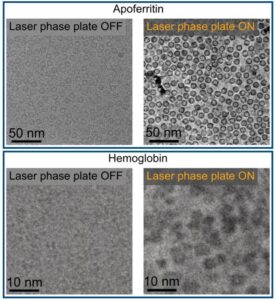
You know when you are at the eye doctor getting an updated prescription, and suddenly the world snaps into sharper focus? Physicists at the University of California (UC), Berkeley, have now done something similar for electron microscopy. By introducing phase contrast into a cryo‑electron microscope, they have delivered dramatically sharper images of some of biology’s smallest and most elusive proteins.
The advance comes from a new laser phase plate (LPP), described in the paper “Laser phase plate improves structure determination of small proteins by cryo‑EM,” which was published recently in Science. Led by physicist Holger Mueller, PhD, of UC Berkeley and Lawrence Berkeley National Laboratory, the team demonstrated that a laser‑driven phase plate can overcome one of cryo‑EM’s most persistent limitations: poor contrast for small proteins.
Cryo‑EM has transformed structural biology over the past decade, earning a Nobel Prize in 2017 for enabling high‑resolution structures without crystallization. But despite its impact, the technique still struggles with proteins below ~70 kilodaltons—a size range that includes about 90% of the human proteome. “Because of signal-to-noise limitations, the majority of human and animal proteins are too small to be analyzed by these methods [cryo-EM and cryoelectron tomography]. The increase in signal-to-noise ratio provided by this laser phase plate is expected to overcome these important limitations.”
The new LPP begins to address that problem. The LPP uses an intense, continuous‑wave laser to shift the phase of the electron beam itself. This produces true phase contrast without dimming or destabilizing the beam. Mueller described the laser focus as “75 kilowatts focused to a few microns… That’s more powerful than what you use for welding. It has more power than a military laser. It builds up the brightest continuous laser focus ever.”
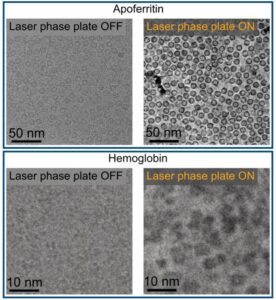
Installed in a custom Thermo Fisher Titan Krios, the LPP immediately improved the clarity and resolvability of small proteins, including hemoglobin, which sits at the lower limit of what today’s cryo‑EM instruments can handle. As the authors wrote in the abstract: “Here, we show that the laser phase plate (LPP)… enhances the resolution in single-particle reconstruction of small proteins by improving specimen-motion correction, recovery of information from the early frames, as well as particle visualization, 3D classification, and alignment.”
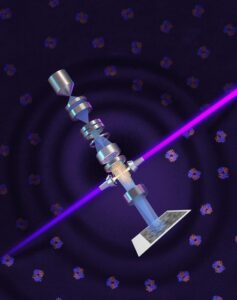
These improvements were achieved using standard defocus ranges and reconstruction workflows. “For the most challenging cases—small particles, bad specimens—the laser produces a very considerable advantage,” Mueller said.
The impact extends beyond single‑particle analysis. Cryo‑electron tomography (cryo‑ET), which assembles multiple angular views of a molecule or protein into a three-dimensional image, stands to benefit even more. “With cryo-ET, we’re looking at small, very complicated cellular material that’s incredibly crowded inside the cell,” said Bridget Carragher, PhD, founding technical director of imaging at Biohub. “It’s like a forest of trees, and you’re trying to find one leaf on one tree in there. Cryo-ET needs a dramatic step forward in contrast, so we can start to see what’s going on inside the cell. That’s what the laser phase plate promises to give us.”
Biohub is developing a dual‑laser version of the system, designed to reduce component wear and minimize aberrations. Meanwhile, Mueller’s team is pushing toward imaging proteins as small as 17 kilodaltons, a threshold that would open access to vast regions of the human proteome previously invisible to cryo‑EM.
“This technology is a step function change for biology,” said Stephani Otte, PhD, Biohub’s vice president of imaging science. “What was once invisible will become visible—and that changes everything about how we understand disease.”
“The bottom line is, if you have a large protein and a really good sample—a fresh one or one frozen without bubbles, for example—you may not need the phase plate to get a single, high-quality image. But for a small protein and a bad sample, laser-on is best,” Mueller said. “This could fill an enormous gap in our knowledge of protein structures that can’t be crystallized or are too small for today’s cryo-EM. And it will be revolutionary for cryo-ET.”
The post Laser‑Driven Phase Contrast Enhances Cryo‑EM Resolution of Small Proteins appeared first on GEN – Genetic Engineering and Biotechnology News.
Uncategorized
STAT+: Updated: Tracking RFK Jr.’s promises to remake health in America
Updated June 11, 2026
WASHINGTON — A pledge to “Make America Healthy Again” earned Robert F. Kennedy Jr. his job atop U.S. health agencies a year and some change ago. He’s now had the opportunity to turn his words into action, with mixed results.
“All one needs” to prove the health secretary’s attentiveness is to “review my unprecedented list of accomplishments on a wide range of issues, all of which I drove,” Kennedy posted on X on Wednesday in response to a journalist.

Updated June 11, 2026
WASHINGTON — A pledge to “Make America Healthy Again” earned Robert F. Kennedy Jr. his job atop U.S. health agencies a year and some change ago. He’s now had the opportunity to turn his words into action, with mixed results.
“All one needs” to prove the health secretary’s attentiveness is to “review my unprecedented list of accomplishments on a wide range of issues, all of which I drove,” Kennedy posted on X on Wednesday in response to a journalist.

Can any of the new obesity medications in development stand out from the pack? Which company just broke records with its IPO? And will the Food and Drug Administration allow greater access to experimental peptides?
We discuss all that and more on this week’s episode of “The Readout LOUD,” STAT’s biotech podcast.


Illinois’ financial crisis could bring the state to a halt
The final 6 ‘Game of Thrones’ episodes might feel like a full season
New Season 8 Walking Dead trailer flashes forward in time
Mod turns ‘Counter-Strike’ into a ‘Tekken’ clone with fighting chickens
Meet Superman’s grandfather in new trailer for Krypton
Disney’s live-action Aladdin finally finds its stars

Laser‑Driven Phase Contrast Enhances Cryo‑EM Resolution of Small Proteins

STAT+: Updated: Tracking RFK Jr.’s promises to remake health in America

An obesity drug deep-dive, and peptides move mainstream

RFK Jr. claims his calendar is publicly available. We’ve been trying to get it for a year

Nonprofit buys experimental cancer drug to maintain patient access
Potential Cocaine Addiction Targets Identified Through Genetic Mapping in Rats
Illinois’ financial crisis could bring the state to a halt
The final 6 ‘Game of Thrones’ episodes might feel like a full season
New Season 8 Walking Dead trailer flashes forward in time
Mod turns ‘Counter-Strike’ into a ‘Tekken’ clone with fighting chickens
Meet Superman’s grandfather in new trailer for Krypton
Disney’s live-action Aladdin finally finds its stars
-
 Uncategorized9 years ago
These ’90s fashion trends are making a comeback in 2017
-
Uncategorized9 years ago
According to Dior Couture, this taboo fashion accessory is back
-
Endpoints News3 months ago
Novartis to pay $2B upfront to take next-gen PI3Kα inhibitor from Synnovation
-
Uncategorized9 years ago
Phillies’ Aaron Altherr makes mind-boggling barehanded play
-
Uncategorized9 years ago
Uber and Lyft are finally available in all of New York State
-
Contributors9 years ago
The final 6 ‘Game of Thrones’ episodes might feel like a full season
-
Uncategorized9 years ago
Steph Curry finally got the contract he deserves from the Warriors
-
Uncategorized9 years ago
The old and New Edition cast comes together to perform