
Uncategorized
Parkinson’s Disease Medication Monitored with Fingertip Sweat Patch

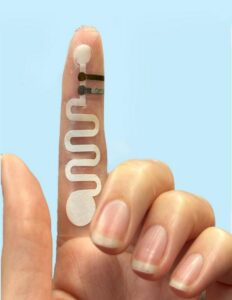
Engineers and neuroscientists at the University of California (UC) San Diego have developed a soft, wearable fingertip patch that continuously tracks a Parkinson’s disease (PD) patient’s levodopa medication levels by measuring chemicals in their sweat, with no batteries required. Tests in healthy volunteers and in Parkinson’s disease patients showed that measurements generated using the device were comparable to those obtained by standard laboratory blood tests.
The wearable device offers a way to continuously track real-time concentrations of levodopa in the body and could enable doctors to precisely customize daily medication schedules for patients at home.
The research was led by Tamoghna Saha, PhD, a postdoctoral researcher in the lab of Joseph Wang, DSc, professor in the Aiiso Yufeng Li Family Department of Chemical and Nano Engineering at the UC San Diego Jacobs School of Engineering. Saha is co-first author of the team’s published paper in PNAS titled “A wearable patch for continuous levodopa monitoring in sweat: Towards exertion and power-free pharmacodynamic assessment in Parkinson’s disease.” In their paper the authors wrote in summary, “Overall, our easy-to-use, energy-efficient wearable supports real-time, stimulation-free monitoring, potentially enabling at-home dosage adjustments and paving the way for future autonomous closed-loop L-dopa therapeutic system development.”
Parkinson’s disease is the second most common and fastest-growing neurodegenerative disorder worldwide, the author wrote. “While no cure for PD exists, levodopa (L-dopa) is the most effective symptomatic treatment, which is typically administered via oral tablets or capsules, and in advanced cases, through inhaled powder or continuous intrajejunal or subcutaneous infusions.” Prescribing the right dose is challenging: reducing levodopa leaves patients unable to move, while too much triggers severe, uncontrollable jerking movements. Initially, the drug’s effects can last several hours.
But as the disease progresses, the therapeutic window narrows down to two hours. Currently, clinicians must rely on subjective patient diaries to adjust treatment. Unfortunately, these methods fail to catch dangerous dosing gaps. “Precision management of Parkinson’s disease (PD) requires frequent levodopa (L-dopa) dose adjustments, yet current monitoring relies on subjective symptom reporting and infrequent blood testing,” the team continued.
![Levodopa monitoring patch showing the assembly of the hydrogel and levodopa sensor with the paper fluidic channel on the fingertip. [Tamoghna Saha.]](https://www.genengnews.com/wp-content/uploads/2026/07/Low-Res_26-10453-2-232x300.jpg)
Saha and the engineering team developed the new finger patch technology in joint collaboration with the lab of Irene Litvan, MD, MPhil, professor in the department of neurosciences at UC San Diego School of Medicine. The project is part of a longstanding collaboration between the Wang and Litvan teams to develop wearable levodopa monitors that can improve personalized care for people living with PD.
Worn on the fingertip, which is packed with a high density of sweat glands, the patch is equipped with a specially engineered absorbent gel that acts like a sweat sponge. The gel contains a highly-concentrated mixture of salts and benign solvents—and that draws sweat out of the pores, since water naturally flows toward areas with higher salt concentrations. Collected sweat is drawn into a serpentine fluidic channel with a self-powered levodopa biosensor connected to a wireless transmitter.
When levodopa in the patient’s sweat comes into contact with enzymes embedded in the patch it triggers a chemical reaction, which in turn generates a small, measurable voltage. This chemical reaction is what powers the patch. The amount of voltage generated also serves as an indicator of the patient’s levodopa level, such that lower voltage signals low levels, while higher voltage signals high levels.
![Unassembled integrated levodopa monitoring patch. [David Baillot (University of California, San Diego, San Diego, CA).]](https://www.genengnews.com/wp-content/uploads/2026/07/Low-Res_2026-10453-3-300x200.jpeg)
Experimental results from three to five healthy participants and four individuals with PD indicated that levodopa concentrations in sweat measured by the patch are strongly correlated with blood concentrations measured by high-performance liquid chromatography. The patches captured pharmacodynamic responses and patient-specific levodopa clearance trends that could be used to calibrate dosage estimates for individuals.
The data revealed that individuals with Parkinson’s clear levodopa from their systems significantly faster than healthy individuals. This result explains why a patient’s Parkinson’s symptoms can deteriorate so suddenly, the researchers noted.
This technology could lay the groundwork for a closed-loop system, where a levodopa monitoring patch could communicate with a pump to automatically deliver the precise doses of the drug right when the body needs it, the authors suggested. “This approach establishes a foundation for real-time, at-home therapeutic optimization and advances the development of future closed-loop treatment systems for PD.”
The post Parkinson’s Disease Medication Monitored with Fingertip Sweat Patch appeared first on GEN – Genetic Engineering and Biotechnology News.


The California Supreme Court sided with Gilead Sciences in a closely watched case brought by thousands of patients who argued the company was negligent for slow-walking development of an HIV medicine that was safer than another drug it was already selling.
In a 6-1 decision, the court overturned a state appeals court ruling two years ago that Gilead could be held liable, raising alarm in the pharmaceutical industry that drug development decisions could be influenced by the fear of legal liability.
The case began after more than 24,000 people claimed in federal and state court lawsuits that they unnecessarily suffered kidney injury and bone loss from the older drug. They maintained that Gilead cynically managed its product pipeline at the expense of people who should have been treated with a safer medicine.
Uncategorized
Combined Phage Therapy and FMT Reduces Recurrent UTIs and Antibiotic Use in First Human Case Series
Recurrent urinary tract infections (rUTIs) are among the most common bacterial infections worldwide. The difficult-to-treat condition, which affects primarily women, is defined as two urinary tract infections (UTIs) within six months or three UTIs within the past year. They are a leading cause of outpatient antibiotic use, accounting for more than 15% of all prescriptions.
While antibiotics remain the standard treatment, frequent recurrences and rising antibiotic resistance highlight the need for alternative therapeutic approaches. Now, researchers have, for the first time, administered a combined phage therapy (PT) with fecal microbiota transplantation (FMT), to decolonize urinary and intestinal reservoirs of rUTI patients.
The novel treatment approach, combining PT and elective FMT, was administered to three female patients, between May and July 2023, with rUTI that did not respond to antibiotics and commonly used non-antibiotic strategies. All had microbiologically confirmed E. coli in multiple infections.
All three women received PT orally and intravesically (locally applied to the bladder via catheter) for eight days outside of acute episodes. Two of these three patients were elected to receive subsequent FMT. Since the bacteria causing the recurring infections often reside in the gut as well as the urinary tract, the FMT treatment targeted the intestinal reservoirs of E. coli that survive antibiotic treatment of acute infections and can become increasingly resistant.
“While phage therapy acts to remove the pathogen, FMT aims to restore a healthy microbiome, combining both immediate and long-term effects,” Lena Biehl, MD, PhD, group leader at Fraunhofer ITMP, deputy lead of Cologne Microbiota Bank, University Hospital Cologne.
This work is published in Nature Microbiology in the paper, “Combined Phage therapy and fecal microbiota transplantation to treat recurrent urinary tract infection: a case series.”
The treatments were well tolerated and did not result in noticeable side effects. The two patients who received the combination therapy have experienced a long-term reduction of UTIs over the course of two years, while the one patient with PT only has experienced further episodes but with reduced symptoms. For all patients, although E. coli was detected in follow-up samples, quality of life improved significantly, while the need for antibiotic treatment was substantially reduced.
“Three patients are not a sufficiently large sample to establish this new therapy, and control groups were lacking. However, this experience has helped to lay the foundation for a clinical trial in order to test the clinical utility of this treatment approach and make it more widely available and sustainable for patients,” comments Shawna McCallin, MD, at the Balgrist University Hospital in Zurich.
The clinical trial is scheduled to begin in June 2027 at the participating institutions as part of the REPhRAME project, which is funded by the European Commission through the Horizon Europe funding programme.
The post Combined Phage Therapy and FMT Reduces Recurrent UTIs and Antibiotic Use in First Human Case Series appeared first on GEN – Genetic Engineering and Biotechnology News.
Uncategorized
STAT+: After Eli Lilly granted one man special access to obesity drug, doctors struggle to get answers
Last month, STAT reported that Eli Lilly granted a single 79-year-old patient special access to retatrutide, an unapproved obesity drug that has demonstrated bariatric-surgery levels of weight loss.
Since then, at least a handful of clinicians have tried to seek the same access for their patients. Two of them haven’t received answers from the drugmaker for weeks; one heard back on Monday, only after STAT reached out to Lilly with questions for this story, that his patient might qualify for access to the drug.
The lack of clarity from Lilly raises new questions about why the company gave extraordinary access to an experimental obesity drug to a single patient. Clinicians are calling for more transparency from Lilly on whether the company plans to expand access, or whether this was a one-time, special circumstance.

Last month, STAT reported that Eli Lilly granted a single 79-year-old patient special access to retatrutide, an unapproved obesity drug that has demonstrated bariatric-surgery levels of weight loss.
Since then, at least a handful of clinicians have tried to seek the same access for their patients. Two of them haven’t received answers from the drugmaker for weeks; one heard back on Monday, only after STAT reached out to Lilly with questions for this story, that his patient might qualify for access to the drug.
The lack of clarity from Lilly raises new questions about why the company gave extraordinary access to an experimental obesity drug to a single patient. Clinicians are calling for more transparency from Lilly on whether the company plans to expand access, or whether this was a one-time, special circumstance.


Illinois’ financial crisis could bring the state to a halt
The final 6 ‘Game of Thrones’ episodes might feel like a full season
New Season 8 Walking Dead trailer flashes forward in time
Mod turns ‘Counter-Strike’ into a ‘Tekken’ clone with fighting chickens
Meet Superman’s grandfather in new trailer for Krypton
Disney’s live-action Aladdin finally finds its stars

STAT+: California Supreme Court sides with Gilead in ‘duty’ to innovate case
Combined Phage Therapy and FMT Reduces Recurrent UTIs and Antibiotic Use in First Human Case Series

STAT+: After Eli Lilly granted one man special access to obesity drug, doctors struggle to get answers

Michigan reports first two U.S. deaths in outbreak of cyclospora

An AstraZeneca-Bristol Myers megamerger? Wall Street isn’t thrilled.

STAT+: Medicare eliminates key pathways used by ‘breakthrough’ devices for extra payments
Illinois’ financial crisis could bring the state to a halt
The final 6 ‘Game of Thrones’ episodes might feel like a full season
New Season 8 Walking Dead trailer flashes forward in time
Mod turns ‘Counter-Strike’ into a ‘Tekken’ clone with fighting chickens
Meet Superman’s grandfather in new trailer for Krypton
Disney’s live-action Aladdin finally finds its stars
-
Fierce Biotech4 months ago
Scientists turn pig semen extract into eye drops that kill cancer in mice
-
 Uncategorized9 years ago
These ’90s fashion trends are making a comeback in 2017
-
Endpoints News5 months ago
Novartis to pay $2B upfront to take next-gen PI3Kα inhibitor from Synnovation
-

 Uncategorized4 months ago
Novartis buys Synnovation’s PI3Kα inhibitors for $3 billion
-
Uncategorized9 years ago
According to Dior Couture, this taboo fashion accessory is back
-
Uncategorized9 years ago
Steph Curry finally got the contract he deserves from the Warriors
-
Uncategorized9 years ago
Phillies’ Aaron Altherr makes mind-boggling barehanded play
-
Uncategorized9 years ago
Uber and Lyft are finally available in all of New York State