
Uncategorized
Low-Cost, Portable Biotech Tools Improve Access to Bioresearch and Diagnostics

A global research team headed by scientists at University of Toronto’s Leslie Dan Faculty of Pharmacy has demonstrated the effectiveness of a suite of low-cost, portable biotechnology tools that are designed to improve access to laboratory research and diagnostics in resource-limited settings.
The newly reported study highlights how decentralized biomanufacturing tools and freeze-dried reagents can help researchers produce high-value biological materials locally—reducing reliance on fragile international supply chains and expanding access to life sciences innovation globally.
“For labs in low- and middle-income countries [LMICs], access to high-quality supplies and equipment is a chronic problem,” says research lead Keith Pardee, PhD, associate professor at the Leslie Dan Faculty of Pharmacy Pardee. “Shipping can take a long time, it’s expensive, and products often require a cold chain to retain their effectiveness. This research is in response to those challenges to develop tools that are more accessible for labs in lower-resource settings and improve research equity.”
Pardee, alongside collaborators including Camila González, PhD, at the Universidad de los Andes, Bogotá, Fernán Federici, PhD, at Millennium Institute for Integrative Biology (iBio), Santiago, and Lindomar Pena, PhD, at Aggeu Magalhães Institute (IAM), Oswaldo Cruz Foundation (Fiocruz), Recife, reported on the study in Science Advances. In their paper, “International multisite implementation of distributed cell-free protein biomanufacturing to advance health and research equity,” the authors concluded, “This study lays the foundation for fundamental shifts in biotechnology manufacturing practices in LMICs and developing nations, moving from reliance on centralized and outsourced production facilities to adopting decentralized, local production platforms.”
“Emerging biotechnologies hold transformative potential to strengthen economic and health security, while benefiting the planet,” the authors wrote. However, they pointed out, “Access to advanced tools, such as molecular diagnostics, life-saving treatments, and biomanufacturing infrastructure, remains largely concentrated in wealthier regions, thereby restricting access to transformative solutions for communities that need them most.”
A key factor is the reliance on centralized bioproduction systems, “… which require sophisticated, capital-intensive infrastructure and cold supply chains that are often unavailable in resource-limited settings.” Access to healthcare is similarly affected by the availability of biomanufacturing capacity and biologistics, which can slow delivery of diagnostics, delay disease control programs, and limit the ability to carry out life sciences research.
For their newly reported work the team focused on synthetic biology and cell-free systems—technologies that isolate and freeze-dry the molecular machinery needed to produce proteins commonly used in life sciences research. Because the reagents are freeze-dried, they can be shipped and stored without refrigeration, then reactivated simply by adding water. “One promising avenue to improving access is cell-free protein synthesis (CFPS), which offers the potential to empower communities through affordable, low-burden, on-site production of critical bioreagents, diagnostic tools, and therapeutic agents,” the researchers stated.
They paired these systems with low-cost, adaptable hardware, including a 3D-printed hand-powered centrifuge developed by postdoctoral fellow Mohammad Simchi, PhD, at the Leslie Dan Faculty of Pharmacy. Together, the technologies enabled teams to produce a range of research proteins and diagnostic tools in diverse settings, from conventional laboratories to remote field locations.
“With efficient, low-cost systems in place, rapid on-site production of high-value bioproducts for research, including growth factors, vaccines, and diagnostic enzymes, became achievable within a single day and at a fraction of the typical cost,” they commented.
Using the platform, researchers successfully produced growth factors used in life sciences research and therapeutics, as well as a SARS-CoV-2 vaccine candidate tested in mice and diagnostic tools targeting several clinically relevant pathogens. Using molecular, cell-based, animal model, and clinical sample testing, the bioproducts were validated through proof-of-concept studies and multisite clinical trials. “Direct comparisons with high-cost commercial reagents, the current gold standards, demonstrated similar performance, efficiency, precision, and reproducibility,” the investigators further noted.
First author Severino Jefferson Ribeiro da Silva, PhD, a postdoctoral fellow in Pardee’s lab, said, “Our work shows that it is possible to produce high-value bioreagents on site, essentially anywhere. Through this work, we demonstrated our tools across diverse international settings while maintaining performance comparable to commercial products.”
The authors say that, to their knowledge, the study is the first to translate cell-free biomanufacturing from laboratory to real-world use, across multiple geographic settings, including those that historically have had limited access to the bioeconomy. “By prioritizing accessibility, affordability, and reproducibility, we show that cell-free biomanufacturing is a transformative tool for expanding global research capacity and, ultimately, health equity and participation in the bioeconomy.”
A key component of the project involved testing the systems in a variety of environments across Canada and internationally. Da Silva travelled to the Algonquin Highlands to evaluate diagnostic tools for tick-borne pathogens and tuberculosis, while graduate student Quinn Matthews travelled to the Yukon where he produced and purified proteins using the portable system on a mountain outside Whitehorse.
Collaborators in Chile, Brazil, Colombia, and India also tested the systems, helping ensure the technologies addressed the practical realities faced by researchers in different regions. The project involved extensive international collaboration, including regular meetings, student exchanges and knowledge sharing among participating teams.
Da Silva says the research team experienced first-hand many of the logistical challenges their collaborators routinely face, including lengthy customs delays and damaged shipments containing critical reagents.
“Those experiences highlighted how dependent many researchers and labs still are on fragile international supply chains. If a shipment is delayed, an entire project can stop,” says da Silva. “This work makes it possible to reduce that dependency by enabling local production of key proteins directly at the point of need.”
The researchers say the long-term goal is to help research labs in remote and underserved regions gain access to high-quality diagnostics, research reagents and biomanufacturing capabilities produced closer to home, strengthening resilience against future supply chain disruptions while empowering their research capacity and address local healthcare needs. “With their low cost and operational simplicity, we see these platforms and similar disruptive technologies … as part of a new generation of tools that will help shape a future in which bioreagents, advanced diagnostics, and life-saving therapeutics are accessible to all.”
Da Silva added, “This work is really about access and scientific empowerment. Many labs worldwide have the expertise and ideas to conduct life sciences and applied science research, but they face major challenges accessing key bioreagents and essential materials. Decentralized biomanufacturing could help reduce those barriers and make research and diagnostics more accessible globally.”
The post Low-Cost, Portable Biotech Tools Improve Access to Bioresearch and Diagnostics appeared first on GEN – Genetic Engineering and Biotechnology News.

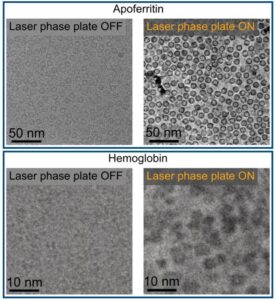
You know when you are at the eye doctor getting an updated prescription, and suddenly the world snaps into sharper focus? Physicists at the University of California (UC), Berkeley, have now done something similar for electron microscopy. By introducing phase contrast into a cryo‑electron microscope, they have delivered dramatically sharper images of some of biology’s smallest and most elusive proteins.
The advance comes from a new laser phase plate (LPP), described in the paper “Laser phase plate improves structure determination of small proteins by cryo‑EM,” which was published recently in Science. Led by physicist Holger Mueller, PhD, of UC Berkeley and Lawrence Berkeley National Laboratory, the team demonstrated that a laser‑driven phase plate can overcome one of cryo‑EM’s most persistent limitations: poor contrast for small proteins.
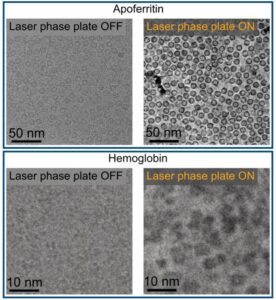
Cryo‑EM has transformed structural biology over the past decade, earning a Nobel Prize in 2017 for enabling high‑resolution structures without crystallization. But despite its impact, the technique still struggles with proteins below ~70 kilodaltons—a size range that includes about 90% of the human proteome. “Because of signal-to-noise limitations, the majority of human and animal proteins are too small to be analyzed by these methods [cryo-EM and cryoelectron tomography]. The increase in signal-to-noise ratio provided by this laser phase plate is expected to overcome these important limitations.”
The new LPP begins to address that problem. The LPP uses an intense, continuous‑wave laser to shift the phase of the electron beam itself. This produces true phase contrast without dimming or destabilizing the beam. Mueller described the laser focus as “75 kilowatts focused to a few microns… That’s more powerful than what you use for welding. It has more power than a military laser. It builds up the brightest continuous laser focus ever.”
Installed in a custom Thermo Fisher Titan Krios, the LPP immediately improved the clarity and resolvability of small proteins, including hemoglobin, which sits at the lower limit of what today’s cryo‑EM instruments can handle. As the authors wrote in the abstract: “Here, we show that the laser phase plate (LPP)… enhances the resolution in single-particle reconstruction of small proteins by improving specimen-motion correction, recovery of information from the early frames, as well as particle visualization, 3D classification, and alignment.”
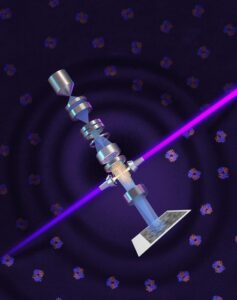
These improvements were achieved using standard defocus ranges and reconstruction workflows. “For the most challenging cases—small particles, bad specimens—the laser produces a very considerable advantage,” Mueller said.
The impact extends beyond single‑particle analysis. Cryo‑electron tomography (cryo‑ET), which assembles multiple angular views of a molecule or protein into a three-dimensional image, stands to benefit even more. “With cryo-ET, we’re looking at small, very complicated cellular material that’s incredibly crowded inside the cell,” said Bridget Carragher, PhD, founding technical director of imaging at Biohub. “It’s like a forest of trees, and you’re trying to find one leaf on one tree in there. Cryo-ET needs a dramatic step forward in contrast, so we can start to see what’s going on inside the cell. That’s what the laser phase plate promises to give us.”
Biohub is developing a dual‑laser version of the system, designed to reduce component wear and minimize aberrations. Meanwhile, Mueller’s team is pushing toward imaging proteins as small as 17 kilodaltons, a threshold that would open access to vast regions of the human proteome previously invisible to cryo‑EM.
“This technology is a step function change for biology,” said Stephani Otte, PhD, Biohub’s vice president of imaging science. “What was once invisible will become visible—and that changes everything about how we understand disease.”
“The bottom line is, if you have a large protein and a really good sample—a fresh one or one frozen without bubbles, for example—you may not need the phase plate to get a single, high-quality image. But for a small protein and a bad sample, laser-on is best,” Mueller said. “This could fill an enormous gap in our knowledge of protein structures that can’t be crystallized or are too small for today’s cryo-EM. And it will be revolutionary for cryo-ET.”
The post Laser‑Driven Phase Contrast Enhances Cryo‑EM Resolution of Small Proteins appeared first on GEN – Genetic Engineering and Biotechnology News.
Uncategorized
STAT+: Updated: Tracking RFK Jr.’s promises to remake health in America
Updated June 11, 2026
WASHINGTON — A pledge to “Make America Healthy Again” earned Robert F. Kennedy Jr. his job atop U.S. health agencies a year and some change ago. He’s now had the opportunity to turn his words into action, with mixed results.
“All one needs” to prove the health secretary’s attentiveness is to “review my unprecedented list of accomplishments on a wide range of issues, all of which I drove,” Kennedy posted on X on Wednesday in response to a journalist.

Updated June 11, 2026
WASHINGTON — A pledge to “Make America Healthy Again” earned Robert F. Kennedy Jr. his job atop U.S. health agencies a year and some change ago. He’s now had the opportunity to turn his words into action, with mixed results.
“All one needs” to prove the health secretary’s attentiveness is to “review my unprecedented list of accomplishments on a wide range of issues, all of which I drove,” Kennedy posted on X on Wednesday in response to a journalist.

Can any of the new obesity medications in development stand out from the pack? Which company just broke records with its IPO? And will the Food and Drug Administration allow greater access to experimental peptides?
We discuss all that and more on this week’s episode of “The Readout LOUD,” STAT’s biotech podcast.


Illinois’ financial crisis could bring the state to a halt
The final 6 ‘Game of Thrones’ episodes might feel like a full season
New Season 8 Walking Dead trailer flashes forward in time
Mod turns ‘Counter-Strike’ into a ‘Tekken’ clone with fighting chickens
Meet Superman’s grandfather in new trailer for Krypton
Disney’s live-action Aladdin finally finds its stars

Laser‑Driven Phase Contrast Enhances Cryo‑EM Resolution of Small Proteins

STAT+: Updated: Tracking RFK Jr.’s promises to remake health in America

An obesity drug deep-dive, and peptides move mainstream

RFK Jr. claims his calendar is publicly available. We’ve been trying to get it for a year

Nonprofit buys experimental cancer drug to maintain patient access
Potential Cocaine Addiction Targets Identified Through Genetic Mapping in Rats
Illinois’ financial crisis could bring the state to a halt
The final 6 ‘Game of Thrones’ episodes might feel like a full season
New Season 8 Walking Dead trailer flashes forward in time
Mod turns ‘Counter-Strike’ into a ‘Tekken’ clone with fighting chickens
Meet Superman’s grandfather in new trailer for Krypton
Disney’s live-action Aladdin finally finds its stars
-
 Uncategorized9 years ago
These ’90s fashion trends are making a comeback in 2017
-
Uncategorized9 years ago
According to Dior Couture, this taboo fashion accessory is back
-
Endpoints News3 months ago
Novartis to pay $2B upfront to take next-gen PI3Kα inhibitor from Synnovation
-
Uncategorized9 years ago
Phillies’ Aaron Altherr makes mind-boggling barehanded play
-
Uncategorized9 years ago
Uber and Lyft are finally available in all of New York State
-
Contributors9 years ago
The final 6 ‘Game of Thrones’ episodes might feel like a full season
-
Uncategorized9 years ago
Steph Curry finally got the contract he deserves from the Warriors
-
Uncategorized9 years ago
The old and New Edition cast comes together to perform