
Uncategorized
Breaking through the undruggable barrier with TPDs


Alex Bentley, an 1851 Industrial Fellow working with GSK and the University of Strathclyde, discusses how his research into protein degraders will benefit drug discovery efforts across the pharmaceutical industry.
First proposed in the early 2000s, targeted protein degradation (TPD) has emerged as a therapeutic modality with the potential to transform the treatment of disease associated with previously intractable biological targets. The human genome encodes more than 20,000 proteins, many of which have historically been considered “undruggable” due to the absence of well-defined binding pockets or enzymatic activity that can be readily inhibited by conventional small molecules. As a result, a significant proportion of disease-causing proteins, particularly those involved in cancer and inflammatory diseases, remain inadequately treated by existing therapies.
Rather than modulating protein function through inhibition, TPD seeks to eliminate disease-causing proteins entirely from the cell. This shift in approach is enabled by hijacking the ubiquitin-proteasome system (UPS), the cell’s primary pathway for regulating protein turnover. Under normal physiological conditions, the UPS maintains cellular homeostasis by attaching a molecule “tag” known as ubiquitin to unwanted or damaged proteins, marking them for degradation by the proteasome. TPD technologies exploit this system by redirecting it towards proteins of therapeutic interest.
Protein degraders function by recruiting an E3 ubiquitin ligase and a target protein together to form a three-part complex known as a ternary complex. This complex facilitates the tagging of the target protein with ubiquitin — a process called ubiquitination — which leads to its subsequent proteasomal degradation. As degraders act catalytically, each molecule can trigger the degradation of multiple copies of the target protein; this mechanism can lead to sustained biological effects at lower drug exposures compared with traditional inhibitors.
Two principal classes of small-molecule degraders are primarily used in drug discovery: proteolysis-targeting chimeras (PROTACs) and molecular glue degraders. Although both rely on the same proteasome-mediated degradation pathway, they differ in structure, mechanism and design strategy.
PROTACs are bifunctional molecules composed of two distinct ligands connected by a chemical linker. One ligand binds the target protein, while the other binds the enzyme E3 ubiquitin ligase. By physically bringing these two components together, PROTACs promote the formation of the ternary complex required for ubiquitination. The modular nature of PROTACs has made them attractive from a rational design perspective, allowing researchers to combine known ligands for targets and ligases in a systematic way. However, their relatively large molecular size can present challenges related to cellular permeability, pharmacokinetics and oral bioavailability.
Molecular glue degraders, by contrast, are typically smaller and structurally simpler. Rather than acting as a bridge for two proteins, they function by stabilising or promoting an interaction between an E3 ligase and a target protein, which otherwise would not interact. By doing this, the small molecule effectively reprogrammes the ligase to recognise a new substrate. Due to molecular glue degraders often resembling small molecules in size and physicochemical properties, this may offer advantages in terms of drug-like behaviour.
The earliest examples of molecular glue degraders were identified retrospectively through clinical observations rather than rational drug design. In the late 1990s and early 2000s, drugs such as thalidomide and its derivatives were shown to have therapeutic effects in cancer and inflammatory diseases, despite limited understanding of their mechanism of action. It was not until 2010 that these compounds were discovered to bind the E3 ligase cereblon, altering its substrate specificity and triggering degradation of previously stable proteins. This finding provided the first clear demonstration that small molecules could redirect the UPS in a selective and therapeutically meaningful manner.
Since then, interest in molecular glue degraders has grown, driven by advances in structural biology, chemical biology and proteomics. These tools have revealed that E3 ligases enable small molecules to reshape protein-protein interfaces and induce selective degradation. Nevertheless, the discovery of molecular glues remains challenging, as their activity is often difficult to predict and has historically relied on serendipitous approaches. Despite these challenges, TPD continues to gain momentum as a complementary strategy to traditional inhibition-based drug discovery.
While TPD offers a powerful alternative to conventional inhibition-based drug discovery, its broader application is constrained by challenges around selectivity, off-target activity and the efficiency with which new degraders can be discovered and optimised. Addressing these challenges has become an increasingly important focus of research, particularly as the field moves beyond a small number of well-characterised targets and ligands.
My PhD research, which is conducted in a long-standing and thriving industry/academia collaboration between GSK and the University of Strathclyde, seeks to address these limitations through two complementary projects: firstly, by investigating the mechanisms underlying off-target degradation in TPD, and secondly, by developing high-throughput approaches to degrader discovery. This research is supported by a fellowship from the Royal Commission for the Exhibition of 1851, which aims to promote fundamental scientific research with long-term industrial relevance.
The first phase of my research has focused on understanding the behaviour of an essential translation termination factor, namely GSPT1 (G1 to S Phase Transition 1), which has emerged as a recurring off-target in degrader discovery programmes. Although GSPT1 has been explored as a therapeutic target in specific disease areas, it also plays an essential role in normal cellular protein synthesis. As a result, its unintended degradation can lead to cytotoxic effects and complicate the interpretation of biological data.
In several TPD programmes, particularly those employing cereblon-recruiting ligands, apparent degradation of short-lived, disease-relevant proteins has later been explained by indirect effects arising from depletion of GSPT1. By disrupting global protein synthesis, off-target degradation can reduce the levels of short-lived proteins, creating misleading degradation data. This phenomenon represents a significant challenge for degrader discovery, as it can lead to the optimisation of compounds which do not degrade the intended protein.
To address this issue systematically, I have carried out an extensive structure-activity relationship (SAR) study, involving the design, synthesis and biological evaluation of a significant library of molecular glue degraders. This dataset enabled detailed analysis of how specific chemical features influence off-target degradation of GSPT1. Variations in molecule design, including heterocyclic motifs, exit vectors, linker composition and steric environment were explored to identify structural elements that promote or suppress undesired engagement of essential proteins.
The resulting SAR information provides practical design principles which can be used to minimise off-target degradation of GSPT1 in future degrader programmes. More broadly, the study highlights the importance of understanding off-target effects as a predictable and mechanistically driven outcome of degrader chemistry, rather than a rare or incidental observation.
Building on this foundation, the second phase of my research has shifted towards improving efficiency and scalability of degrader discovery. Traditional degrader development is often limited by iterative synthesis and testing cycles, which can be particularly slow when exploring new ligases or large areas of chemical space. To overcome this limitation, my current project adopts a high-throughput direct-to-biology approach.
This work focusses on a less well-investigated E3 ubiquitin ligase, expanding the toolbox of ligases available for targeted protein degradation. By combining this ligase with a direct-to-biology synthetic platform, large libraries of degraders can be generated rapidly and screened without the need for extensive purification. This approach enables thousands of compounds to be synthesised and tested in parallel, significantly accelerating early-stage discovery and improving efficiency. Biological screening is carried out using HiBiT-based assays, which allow quantitative measurement of protein degradation in live cells, providing a sensitive and physiologically relevant readout of degrader activity.
Together, these two projects address two critical barriers facing the TPD field: investigating off-target effects and the rapid exploration of new chemical and biological space. By combining a deeper understanding of degrader behaviour with high-throughput discovery approaches, this research contributes to a more informed and efficient approach to degrader design.
With multiple TPD therapies now progressing through late-stage clinical development, the first degrader-based medicines are expected to reach patients in the near future. As these therapies enter clinical practice, targeted protein degradation is poised to move from a promising emerging modality to an established component of modern drug discovery.
The post Breaking through the undruggable barrier with TPDs appeared first on Drug Discovery World (DDW).

Strong science, lower costs and growing capital networks are putting Spain and Portugal on the biotech investment map, even as structural bottlenecks persist, according to two investors.
You know when you are at the eye doctor getting an updated prescription, and suddenly the world snaps into sharper focus? Physicists at the University of California (UC), Berkeley, have now done something similar for electron microscopy. By introducing phase contrast into a cryo‑electron microscope, they have delivered dramatically sharper images of some of biology’s smallest and most elusive proteins.
The advance comes from a new laser phase plate (LPP), described in the paper “Laser phase plate improves structure determination of small proteins by cryo‑EM,” which was published recently in Science. Led by physicist Holger Mueller, PhD, of UC Berkeley and Lawrence Berkeley National Laboratory, the team demonstrated that a laser‑driven phase plate can overcome one of cryo‑EM’s most persistent limitations: poor contrast for small proteins.
Cryo‑EM has transformed structural biology over the past decade, earning a Nobel Prize in 2017 for enabling high‑resolution structures without crystallization. But despite its impact, the technique still struggles with proteins below ~70 kilodaltons—a size range that includes about 90% of the human proteome. “Because of signal-to-noise limitations, the majority of human and animal proteins are too small to be analyzed by these methods [cryo-EM and cryoelectron tomography]. The increase in signal-to-noise ratio provided by this laser phase plate is expected to overcome these important limitations.”
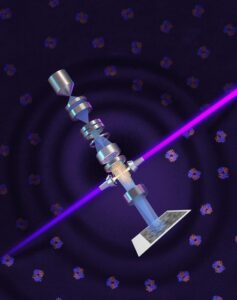
The new LPP begins to address that problem. The LPP uses an intense, continuous‑wave laser to shift the phase of the electron beam itself. This produces true phase contrast without dimming or destabilizing the beam. Mueller described the laser focus as “75 kilowatts focused to a few microns… That’s more powerful than what you use for welding. It has more power than a military laser. It builds up the brightest continuous laser focus ever.”
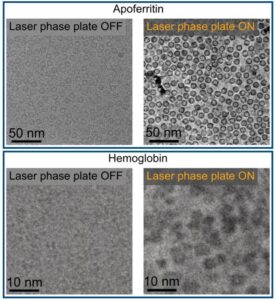
Installed in a custom Thermo Fisher Titan Krios, the LPP immediately improved the clarity and resolvability of small proteins, including hemoglobin, which sits at the lower limit of what today’s cryo‑EM instruments can handle. As the authors wrote in the abstract: “Here, we show that the laser phase plate (LPP)… enhances the resolution in single-particle reconstruction of small proteins by improving specimen-motion correction, recovery of information from the early frames, as well as particle visualization, 3D classification, and alignment.”
These improvements were achieved using standard defocus ranges and reconstruction workflows. “For the most challenging cases—small particles, bad specimens—the laser produces a very considerable advantage,” Mueller said.
The impact extends beyond single‑particle analysis. Cryo‑electron tomography (cryo‑ET), which assembles multiple angular views of a molecule or protein into a three-dimensional image, stands to benefit even more. “With cryo-ET, we’re looking at small, very complicated cellular material that’s incredibly crowded inside the cell,” said Bridget Carragher, PhD, founding technical director of imaging at Biohub. “It’s like a forest of trees, and you’re trying to find one leaf on one tree in there. Cryo-ET needs a dramatic step forward in contrast, so we can start to see what’s going on inside the cell. That’s what the laser phase plate promises to give us.”
Biohub is developing a dual‑laser version of the system, designed to reduce component wear and minimize aberrations. Meanwhile, Mueller’s team is pushing toward imaging proteins as small as 17 kilodaltons, a threshold that would open access to vast regions of the human proteome previously invisible to cryo‑EM.
“This technology is a step function change for biology,” said Stephani Otte, PhD, Biohub’s vice president of imaging science. “What was once invisible will become visible—and that changes everything about how we understand disease.”
“The bottom line is, if you have a large protein and a really good sample—a fresh one or one frozen without bubbles, for example—you may not need the phase plate to get a single, high-quality image. But for a small protein and a bad sample, laser-on is best,” Mueller said. “This could fill an enormous gap in our knowledge of protein structures that can’t be crystallized or are too small for today’s cryo-EM. And it will be revolutionary for cryo-ET.”
The post Laser‑Driven Phase Contrast Enhances Cryo‑EM Resolution of Small Proteins appeared first on GEN – Genetic Engineering and Biotechnology News.
Uncategorized
STAT+: Updated: Tracking RFK Jr.’s promises to remake health in America
Updated June 11, 2026
WASHINGTON — A pledge to “Make America Healthy Again” earned Robert F. Kennedy Jr. his job atop U.S. health agencies a year and some change ago. He’s now had the opportunity to turn his words into action, with mixed results.
“All one needs” to prove the health secretary’s attentiveness is to “review my unprecedented list of accomplishments on a wide range of issues, all of which I drove,” Kennedy posted on X on Wednesday in response to a journalist.

Updated June 11, 2026
WASHINGTON — A pledge to “Make America Healthy Again” earned Robert F. Kennedy Jr. his job atop U.S. health agencies a year and some change ago. He’s now had the opportunity to turn his words into action, with mixed results.
“All one needs” to prove the health secretary’s attentiveness is to “review my unprecedented list of accomplishments on a wide range of issues, all of which I drove,” Kennedy posted on X on Wednesday in response to a journalist.


Illinois’ financial crisis could bring the state to a halt
The final 6 ‘Game of Thrones’ episodes might feel like a full season
New Season 8 Walking Dead trailer flashes forward in time
Mod turns ‘Counter-Strike’ into a ‘Tekken’ clone with fighting chickens
Meet Superman’s grandfather in new trailer for Krypton
Disney’s live-action Aladdin finally finds its stars
Beyond sunshine: Iberia’s biotech moment has arrived with developing capital networks

Laser‑Driven Phase Contrast Enhances Cryo‑EM Resolution of Small Proteins

STAT+: Updated: Tracking RFK Jr.’s promises to remake health in America

An obesity drug deep-dive, and peptides move mainstream

RFK Jr. claims his calendar is publicly available. We’ve been trying to get it for a year

Nonprofit buys experimental cancer drug to maintain patient access
Illinois’ financial crisis could bring the state to a halt
The final 6 ‘Game of Thrones’ episodes might feel like a full season
New Season 8 Walking Dead trailer flashes forward in time
Mod turns ‘Counter-Strike’ into a ‘Tekken’ clone with fighting chickens
Meet Superman’s grandfather in new trailer for Krypton
Disney’s live-action Aladdin finally finds its stars
-
 Uncategorized9 years ago
These ’90s fashion trends are making a comeback in 2017
-
Uncategorized9 years ago
According to Dior Couture, this taboo fashion accessory is back
-
Endpoints News3 months ago
Novartis to pay $2B upfront to take next-gen PI3Kα inhibitor from Synnovation
-
Uncategorized9 years ago
Phillies’ Aaron Altherr makes mind-boggling barehanded play
-
Uncategorized9 years ago
Uber and Lyft are finally available in all of New York State
-
Contributors9 years ago
The final 6 ‘Game of Thrones’ episodes might feel like a full season
-
Uncategorized9 years ago
Steph Curry finally got the contract he deserves from the Warriors
-
Uncategorized9 years ago
The old and New Edition cast comes together to perform