
Uncategorized
ASGCT 2026: Rare Instance of AAV Integration into Human Genome Linked to Brain Tumor
ASGCT 2026: Rare Instance of AAV Integration into Human Genome Linked to Brain Tumor


BOSTON — A team at Children’s Hospital of Philadelphia (CHOP) led by Rebecca Ahrens-Niklas, MD, PhD, and Lindsey George, MD, has described a case of a brain tumor linked to a rare integration of adeno-associated virus (AAV).
George presented the work at the American Society of Gene and Cell Therapy (ASGCT) conference in a plenary talk selected as the “presidential abstract” by ASGCT president, Terry Flotte, MD. The study, “Neuroepithelial tumor with AAV integration after intracisternal magna vector delivery,” was published in the New England Journal of Medicine.

Over the past 25 years, some 6,000 patients have been treated with some form of AAV gene therapy. In all that time, George said, there have been no established long-term safety concerns, although genome integration events have been reported in mouse and dog studies. But the case documented by George and colleagues at CHOP suggests that the gene therapy field may need to pay more attention to this potential occurrence.
The story began with a 5-year-old boy with an inherited lysosomal disorder, severe MPS1 deficiency (Hurler subtype). The patient received enzyme replacement therapy at six weeks of age, followed by a cord blood stem cell transplant at age four months.
Investigators chose to perform gene therapy when the patient was 13 months old to deliver the iduronidase (IDUA) gene. The vector chosen was an AAV9 serotype, using a cytomegalovirus enhancer and a chicken beta-actin promoter driving the gene. The virus was administered into the boy’s cisterna magna in the base of the skull.
When the boy was five years old, a routine neurological scan revealed a large intraventricular mass that had not been observed two years earlier. Analysis of the tumor revealed it was a PLAG1-driven neuroepithelial tumor—indeed, PLAG1 expression was almost 300 times higher than in other central nervous system tumors studied at CHOP. (PLAG1 is usually only expressed during embryogenesis.)
Surgery to remove the tumor was successful. Eight months after surgery, there are no signs of tumor growth. The boy is also showing advanced neurocognitive function.
Tumor typing
George described RNA sequencing of the tumor, which revealed the fusion of a fragment of the AAV9 vector cassette to exon 5 of the PLAG1 gene on chromosome 8. The resulting transcript is predicted to encode a PLAG1 derivative containing five zinc-finger DNA-binding domains and a C-terminal transcriptional activation domain, which was previously reported to function as a transcriptional activator.
Curiously, the chimeric junction also included a segment of human chromosome 10, which George suspects originated during the vector manufacturing process. The integration event was present in about 40% of the total reads, suggesting integration into one of the two PLAG1 alleles.
George concluded her talk by noting that while the clinical outcome in this patient is so far encouraging, this is evidence that AAV integration can be associated with oncogenesis. The study underscores the need to monitor the most heavily transduced tissues after AAV gene therapy.
While the gene therapy community should be cautious in extrapolating this single case report across all AAV gene therapy programs, George said the study supports the use of the lowest feasible vector dose as well as tissue-specific promoters.
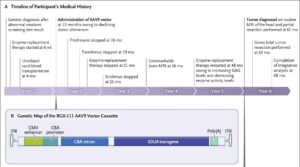
George noted that detection of the integrated AAV vector DNA was challenging, in part because of rearrangements of vector DNA. The use of several complementary techniques—long-read DNA sequencing, targeted PCR amplification, and RNA sequencing—was required to confirm the integration.
George and coworkers closed their paper, noting that, “Our findings support the hypothesis that rare AAV integration can contribute to human oncogenesis, which emphasizes the need to optimize gene delivery methods and monitor transduced tissues after treatment.”
The post ASGCT 2026: Rare Instance of AAV Integration into Human Genome Linked to Brain Tumor appeared first on GEN – Genetic Engineering and Biotechnology News.

Biotechnology company SonoThera has raised $125 million in an oversubscribed Series B financing round. The financing was led by Vida Ventures, with participation from ARK Invest, CureDuchenne Ventures, Leaps by Bayer, Otsuka Pharmaceutical, SymBiosis, UCB Ventures SA, Vivo Capital, and existing investors ARCH Venture Partners, Alexandria Venture Investments, Duquesne Family Office, Illumina Ventures, Johnson & Johnson Innovation – JJDC, Medical Excellence Capital, RA Capital, and Vertex Ventures HC.
SonoThera will use the funds to advance its lead programs in Duchenne muscular dystrophy (DMD) and autosomal dominant polycystic kidney disease (ADPKD) in the clinic. The funds will also support efforts to expand its pipeline of targeted redosable genetic medicines across multiple organ systems and scale its proprietary platform technologies for safe, targeted therapy delivery.
The company’s platform combines a proprietary ultrasound-mediated delivery technology dubbed RIPPLE , with a payload engineering platform dubbed PORE. The platforms are designed to support the development of DNA and RNA therapeutics, gene editing, and gene silencing approaches. SonoThera is using its tech to develop genetic medicines that it claims will address key limitations of conventional gene therapies including delivery challenges, payload size constraints, immune responses, safety events, and difficulties with redosing.
As Kenneth Greenberd, PhD, SonoThera’s co-founder and CEO, stated “we founded SonoThera to take a fundamentally different approach, with a platform designed to broaden the therapeutic possibilities of the field. We believe our technology has the potential to expand the range of diseases addressable by genetic medicines while enabling more precise, durable, safer, and repeatable therapies for patients.”
SonoThera has already demonstrated the targeted delivery and expression capabilities of its platform across multiple tissues, including skeletal muscle, heart, liver, kidney, adipose, and brain. It has also shown that it can deliver large payloads such as full-length dystrophin for DMD and RNA-based payloads for gene silencing applications in preclinical studies.
The company expects to initiate its first clinical trial in DMD in 2027.
Commenting on the financing, Rajul Jain, MD, managing director at Vida Ventures, said “we believe SonoThera, with its RIPPLE delivery and PORE payload engineering technologies, has the potential to unlock opportunities in diseases with significant unmet need that have been previously inaccessible to other genetic medicine approaches.”
In connection with the financing, Jain and Rakhshita Dhar, MS, vice president & head of Healthcare Venture Investments at Leaps by Bayer, have joined SonoThera’s Board of Directors.
The post SonoThera Raises $125M to Develop Ultrasound-Mediated Genetic Medicines appeared first on GEN – Genetic Engineering and Biotechnology News.
Uncategorized
STAT+: Up and down the ladder: The latest comings and goings
Hired someone new and exciting? Promoted a rising star? Finally solved that hard-to-fill spot? Share the news with us, and we’ll share it with others. That’s right. Send us your changes, and we’ll find a home for them. Don’t be shy. Everyone wants to know who is coming and going.
And here is our regular feature in which we highlight a different person each week. This time around, we note that AstronauTx hired Michelle Mellion as chief medical officer. Previously, she held the same role at PepGen and EveryONE Medicines.
But all work and no play can make for a dull chief medical officer.

Hired someone new and exciting? Promoted a rising star? Finally solved that hard-to-fill spot? Share the news with us, and we’ll share it with others. That’s right. Send us your changes, and we’ll find a home for them. Don’t be shy. Everyone wants to know who is coming and going.
And here is our regular feature in which we highlight a different person each week. This time around, we note that AstronauTx hired Michelle Mellion as chief medical officer. Previously, she held the same role at PepGen and EveryONE Medicines.
But all work and no play can make for a dull chief medical officer.
Officials sanctioned Dabur India months after FDA inspectors found bird droppings and data integrity deficiencies during an inspection of the plant.


Illinois’ financial crisis could bring the state to a halt
The final 6 ‘Game of Thrones’ episodes might feel like a full season
New Season 8 Walking Dead trailer flashes forward in time
Mod turns ‘Counter-Strike’ into a ‘Tekken’ clone with fighting chickens
Meet Superman’s grandfather in new trailer for Krypton
Disney’s live-action Aladdin finally finds its stars
SonoThera Raises $125M to Develop Ultrasound-Mediated Genetic Medicines

STAT+: Up and down the ladder: The latest comings and goings
FDA imposes import alert on Indian plant after inspectors flag GMP failings

STAT+: Pharmalittle: We’re reading about a discontinued cancer drug, a Novo security breach, and more
Amgen shores up Tavneos’ FDA defense with Duke data analysis

Chile offers new data on food warning label efficacy
Illinois’ financial crisis could bring the state to a halt
The final 6 ‘Game of Thrones’ episodes might feel like a full season
New Season 8 Walking Dead trailer flashes forward in time
Mod turns ‘Counter-Strike’ into a ‘Tekken’ clone with fighting chickens
Meet Superman’s grandfather in new trailer for Krypton
Disney’s live-action Aladdin finally finds its stars
-
 Uncategorized9 years ago
These ’90s fashion trends are making a comeback in 2017
-
Uncategorized9 years ago
According to Dior Couture, this taboo fashion accessory is back
-
Endpoints News3 months ago
Novartis to pay $2B upfront to take next-gen PI3Kα inhibitor from Synnovation
-
Uncategorized9 years ago
Phillies’ Aaron Altherr makes mind-boggling barehanded play
-
Uncategorized9 years ago
Uber and Lyft are finally available in all of New York State
-
Contributors9 years ago
The final 6 ‘Game of Thrones’ episodes might feel like a full season
-
Uncategorized9 years ago
Steph Curry finally got the contract he deserves from the Warriors
-
Uncategorized9 years ago
The old and New Edition cast comes together to perform