
Uncategorized
10x Genomics Unveils Atera Spatial Platform at AACR Meeting

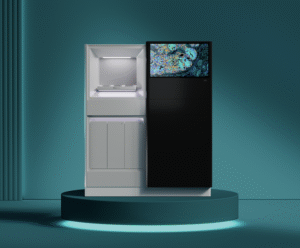
The genomics community’s long wait for 10x Genomics’ highly anticipated news is finally over. On Saturday night, at the Hard Rock Café Hotel in San Diego—across the street from the American Association for Cancer Research (AACR) conference—the company hosted the “Impossible” party to announce its new spatial instrument—the Atera.
Serge Saxonov, PhD, CEO of 10x Genomics, walking onto the stage to thunderous applause, noted that there is “a gap between what we need to see and what we have been able to measure.” The Atera, which enables whole-transcriptome spatial biology at scale, “obliterates the typical trade offs” that come with existing spatial tools, he said.
“This is the biggest launch in our history. I am the most excited I’ve ever been about any product, or any product category, across the board,” Saxonov told GEN. “It has been a long time in development, and it is what we have known the world needs for a long time. I think it will fundamentally change how we measure and understand biology, and it really puts research on a new trajectory. It is really exciting to be at a place now where we can deliver it to the world.”
Nuts and bolts
Atera offers more plex, throughput, and sensitivity than 10x Genomics’ Xenium—enabling whole-transcriptome at scale. More specifically, when compared to Xenium, Atera has four times the throughput, six times higher plex capacity for targeted assays, 3.6x higher plex, and 2–3x sensitivity for whole transcriptome assays.
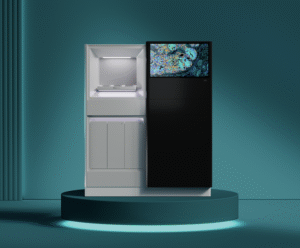
The price for Atera is $495,000, and the instrument measures roughly 53” x 36” x 64” or (4.42 ft × 3 ft × 5.33 ft). Orders are currently being taken, and the instrument will be available in the second half of this year.
The instrument can run up to 800 1 cm2 whole transcriptome samples (FFPE and fresh frozen) per year, with flexible run configurations, and a greater than 5 cm² imageable area per slide (for greater than 2,000 mm² total tissue per run when using all four slides.)
There are 18,000-genes on the Atera WTA (whole transcriptome) with stackable customization of 1,000-gene Atera Select panels available now, and optional stacking of up to three 1,000-gene panels coming in the future.
“Spatial genomics with whole-transcriptome profiling capabilities is the ultimate approach to measure single cells in their tissue context,” Holger Heyn, PhD, ICREA professor at the Centro Nacional de Análisis Genómico (CNAG) and member of the Human Cell Atlas, added. “All other lower-plexity approaches have been just a warm-up phase leading to this application.”
Jasmine Plummer, PhD, associate member of the St. Jude Faculty and director of the Center for Spatial OMICs points out that the whole transcriptome, while exciting, can bring a big “sticker shock” for many researchers because it will require a lot more probes in contrast to a sequencing-based platform, where a library accesses all of the genes.
The instrument uses standard glass microscopy slides, which is exciting to Plummer. In the past, she said, slides have posed a challenge when coordinating with other researchers, and using regular slides will be more “pathology friendly.”
An end to tradeoffs?
Existing spatial technologies, which are still relatively nascent in genomics, have been constrained by tradeoffs between plex, resolution, and throughput. Researchers have had to make choices and prioritize.
“In general, with the landscape as it is today, there is a tradeoff,” Nick Banovich, PhD, VP of scientific development at TGen, and professor of bioinnovation and genome sciences division and director of the Center for Spatial Multi-Omics (COSMO), told GEN. “The closer you walk toward whole transcriptome, the lower the per gene sensitivity.”
“The most exciting thing [about Atara],” he continued, “is that there is still quite good sensitivity with whole transcriptome breadth. That’s the huge advantage of this system; there is no tradeoff anymore.”
However, this launch comes just over three years after Xenium’s launch. Purchasing a new instrument so soon may pose a challenge. Plummer notes: “In this economy, with the uncertainty of scientific funding, it is concerning to ask customers—many of whom just landed a machine—to spend another several hundred thousand dollars.”
Why AACR?
Oncology is one of the most exciting, most promising applications of spatial, especially in the near term, noted Saxonov. This is, in large part, because the work exists across the spectrum—from basic discovery to translation to clinical applications. Spatial is unambiguously important, he asserted.
Unveiling at AACR “just made a lot of sense.”
In addition to the party, the company will host a digital launch event on Tuesday, April 21. Within the AACR program, a presentation from the German Cancer Research Center (DKFZ) will include data generated on the platform, highlighting Atera’s ability to uncover cancer biology not accessible with legacy approaches. Researchers distinguished multiple malignant and stem cell states across disease stages, within a single colorectal tumor sample, and mapped how these populations interact with the surrounding immune microenvironment. The data reveal a more complex immune landscape that could inform future therapeutic strategies and drug development. In addition, two posters (#7116, #6216) will include data from Atera.
The future
10x Genomics said that Atera will play a role in advancing large data studies. For example, the company noted that Atera will enable the goal of the Human Cell Atlas (HCA) as it continues its mission to map every cell type in the human body.
“With the Human Cell Atlas entering its next phase of generating spatially resolved atlases, whole-transcriptome approaches will be the workhorse for data generation,” Heyn told GEN.
“I am excited to see the Atara platform being launched now,” he added. “It is very timely as we ramp up production for the Human Cell Atlas 2.0 phase.”
Atera’s future
The company presented a roadmap with future plans at the AACR event, highlighting spatial proteomics, automation, base by base sequencing (a de novo sequencing assay) and software improvements.
Atera, Saxonov told GEN, is a fundamental platform that the company will continue enabling. It lays the groundwork for the next decade of research and work. This point in time, he said, feels similar to the early days of next generation sequencing (NGS). And although the company will continue to develop its other platforms and product lines, Atera has “massive amounts of headroom to keep building on top of it. It is the convergence of all these different technology stacks and different fields onto one.”
“What the platform can do right out of the gate is exciting. And all the things that it can do in the future will be really, really exciting,” he asserted.
The post 10x Genomics Unveils Atera Spatial Platform at AACR Meeting appeared first on GEN – Genetic Engineering and Biotechnology News.

Uncategorized
STAT+: Up and down the ladder: The latest comings and goings
Hired someone new and exciting? Promoted a rising star? Finally solved that hard-to-fill spot? Share the news with us, and we’ll share it with others. That’s right. Send us your changes, and we’ll find a home for them. Don’t be shy. Everyone wants to know who is coming and going.
And here is our regular feature in which we highlight a different person each week. This time around, we note that AstronauTx hired Michelle Mellion as chief medical officer. Previously, she held the same role at PepGen and EveryONE Medicines.
But all work and no play can make for a dull chief medical officer.

Hired someone new and exciting? Promoted a rising star? Finally solved that hard-to-fill spot? Share the news with us, and we’ll share it with others. That’s right. Send us your changes, and we’ll find a home for them. Don’t be shy. Everyone wants to know who is coming and going.
And here is our regular feature in which we highlight a different person each week. This time around, we note that AstronauTx hired Michelle Mellion as chief medical officer. Previously, she held the same role at PepGen and EveryONE Medicines.
But all work and no play can make for a dull chief medical officer.
Officials sanctioned Dabur India months after FDA inspectors found bird droppings and data integrity deficiencies during an inspection of the plant.
Uncategorized
STAT+: Pharmalittle: We’re reading about a discontinued cancer drug, a Novo security breach, and more
And so, another working week will soon draw to a close. Not a moment too soon, yes? This is, you may recall, our treasured signal to daydream about weekend plans. Our agenda includes promenading with the official mascots, catching another round of live musical vibes here and there, and taking pride in some folks who are dear to us. We also hope to hold yet another listening party, where the rotation will likely include this, this, this, this and this. And what about you? This is a wonderful time of year to sample the many outdoor activities popping up — street fairs, festivals, and all sorts of gatherings can be sampled. If the weather fails to cooperate, though, you could curl up with a good book, sit in front of the telly to take in one or more sporting events, or plan a needed getaway. If none of this strikes your fancy, you could simply park yourself somewhere comfortable for a while and remain zen. Well, whatever you do, have a grand time. But be safe. Enjoy, and see you soon. …
In a rare move, the nonprofit organization Blood Cancer United announced it was buying the remaining supplies of Luvelta, a discontinued investigational cancer drug, STAT reports. As part of the transaction, Blood Cancer United, previously known as the Leukemia & Lymphoma Society, also will acquire the investigational new drug designation and manage the compassionate-use program for children with a rare form of blood cancer, distributing the medication to patients at no cost while supplies last. Sutro Biopharma discontinued development in March 2025 and also eliminated a compassionate use program.
Novo Nordisk identified a security incident in which certain information, including patient data from some clinical trials, was copied externally without authorization from its internal IT systems, Reuters notes. The company said it launched a probe with the assistance of external cybersecurity experts and is in contact with the relevant authorities. The potential categories of personal data affected may include patient ID, year of birth, sex, and health or immunogenicity data among others. Novo did not provide further details, but does not believe the incident will enable any third party to identify participants in its clinical trials.

And so, another working week will soon draw to a close. Not a moment too soon, yes? This is, you may recall, our treasured signal to daydream about weekend plans. Our agenda includes promenading with the official mascots, catching another round of live musical vibes here and there, and taking pride in some folks who are dear to us. We also hope to hold yet another listening party, where the rotation will likely include this, this, this, this and this. And what about you? This is a wonderful time of year to sample the many outdoor activities popping up — street fairs, festivals, and all sorts of gatherings can be sampled. If the weather fails to cooperate, though, you could curl up with a good book, sit in front of the telly to take in one or more sporting events, or plan a needed getaway. If none of this strikes your fancy, you could simply park yourself somewhere comfortable for a while and remain zen. Well, whatever you do, have a grand time. But be safe. Enjoy, and see you soon. …
In a rare move, the nonprofit organization Blood Cancer United announced it was buying the remaining supplies of Luvelta, a discontinued investigational cancer drug, STAT reports. As part of the transaction, Blood Cancer United, previously known as the Leukemia & Lymphoma Society, also will acquire the investigational new drug designation and manage the compassionate-use program for children with a rare form of blood cancer, distributing the medication to patients at no cost while supplies last. Sutro Biopharma discontinued development in March 2025 and also eliminated a compassionate use program.
Novo Nordisk identified a security incident in which certain information, including patient data from some clinical trials, was copied externally without authorization from its internal IT systems, Reuters notes. The company said it launched a probe with the assistance of external cybersecurity experts and is in contact with the relevant authorities. The potential categories of personal data affected may include patient ID, year of birth, sex, and health or immunogenicity data among others. Novo did not provide further details, but does not believe the incident will enable any third party to identify participants in its clinical trials.


Illinois’ financial crisis could bring the state to a halt
The final 6 ‘Game of Thrones’ episodes might feel like a full season
New Season 8 Walking Dead trailer flashes forward in time
Mod turns ‘Counter-Strike’ into a ‘Tekken’ clone with fighting chickens
Meet Superman’s grandfather in new trailer for Krypton
Disney’s live-action Aladdin finally finds its stars

STAT+: Up and down the ladder: The latest comings and goings
FDA imposes import alert on Indian plant after inspectors flag GMP failings

STAT+: Pharmalittle: We’re reading about a discontinued cancer drug, a Novo security breach, and more
Amgen shores up Tavneos’ FDA defense with Duke data analysis

Chile offers new data on food warning label efficacy
Novartis’ $12B Avidity buy pays dividends with Phase 1/2 muscular dystrophy win
Illinois’ financial crisis could bring the state to a halt
The final 6 ‘Game of Thrones’ episodes might feel like a full season
New Season 8 Walking Dead trailer flashes forward in time
Mod turns ‘Counter-Strike’ into a ‘Tekken’ clone with fighting chickens
Meet Superman’s grandfather in new trailer for Krypton
Disney’s live-action Aladdin finally finds its stars
-
 Uncategorized9 years ago
These ’90s fashion trends are making a comeback in 2017
-
Uncategorized9 years ago
According to Dior Couture, this taboo fashion accessory is back
-
Endpoints News3 months ago
Novartis to pay $2B upfront to take next-gen PI3Kα inhibitor from Synnovation
-
Uncategorized9 years ago
Phillies’ Aaron Altherr makes mind-boggling barehanded play
-
Uncategorized9 years ago
Uber and Lyft are finally available in all of New York State
-
Contributors9 years ago
The final 6 ‘Game of Thrones’ episodes might feel like a full season
-
Uncategorized9 years ago
Steph Curry finally got the contract he deserves from the Warriors
-
Uncategorized9 years ago
The old and New Edition cast comes together to perform