
Uncategorized
The top 12 companies hiring in biopharma now


Uncategorized
Opinion: AI won’t enhance physician autonomy. It will further diminish it
Keep your head down. Don’t ask too many questions. Just finish your note and move on.
I heard a version of this command at every level of training and well into my attending practice, from colleagues, seniors, teachers, and administration. Most delivered the advice like it was some sort of hard-won wisdom, though it wasn’t. It was the sound of people who repeated the system’s rules because it felt like control.

Keep your head down. Don’t ask too many questions. Just finish your note and move on.
I heard a version of this command at every level of training and well into my attending practice, from colleagues, seniors, teachers, and administration. Most delivered the advice like it was some sort of hard-won wisdom, though it wasn’t. It was the sound of people who repeated the system’s rules because it felt like control.
For people with severe food allergies, avoiding a trigger food like peanuts or tree nuts can mean constant vigilance. Approximately 8% of children and 10.8% of adults in the United States experience some type of food allergy. Even trace exposures can provoke reactions, and while oral immunotherapy can raise the threshold for some patients, the protection often depends on continued treatment and is associated with disease relapse in many patients. A new study suggests that another route to food tolerance may run through the gut microbiome.
In a small Phase I open-label trial (NCT02960074), researchers at Boston Children’s Hospital tested whether oral encapsulated fecal microbiome transplantation (FMT) could safely increase peanut tolerance in adults with peanut allergy. The work, published in Science Translational Medicine, also used mouse models to probe how donor gut microbes might help restore oral tolerance. The study is titled, “Fecal microbiome transplant in food allergy in humans and mice identifies a role for bile acid metabolites in oral tolerance.”
The trial enrolled 15 adults who reacted to 100 mg or less of peanut protein at baseline, less than half a peanut. Ten participants received a one-time dose of 36 frozen FMT capsules without antibiotic pretreatment; three of these participants showed an increased peanut reactivity threshold after treatment. A second cohort of five participants received antibiotics before FMT, and three of those participants also showed increased tolerance without safety issues, the authors wrote. Across the full study, six of 15 participants met the secondary efficacy endpoint, with responses persisting through the four-month clinical endpoint. No FMT-related allergic reactions or grade 3 or higher adverse events were reported.
“This landmark study was the first to demonstrate that a microbiome-based therapy may improve food allergy in people while also revealing how gut bacteria, their metabolites, and the immune system work together to influence treatment response,” said Rima Rachid, MD, director of the Food Allergy Program and the Allergen Immunotherapy Program at Boston Children’s Hospital.
The mechanistic findings pointed to a possible explanation. In participants who responded to FMT, the researchers observed an increase in tolerogenic RORγt-positive regulatory T cells and a decrease in type 2 helper T cells, immune shifts consistent with restored oral tolerance. When the team transferred post-FMT microbiomes from responders into allergy-prone mice, those mice were protected from the food allergy, whereas mice receiving microbiomes from nonresponders were not.
The responder-associated protection was linked to increased colonization with members of the gut Bacteroides genus and higher levels of bile acid metabolites in both humans and mice. The researchers further showed that deleting a bile salt hydrolase gene from a candidate protective Bacteroides strain weakened food allergy suppression in mice, suggesting that bacterial bile acid metabolism contributes to the tolerogenic effect.
“Food allergy reflects a failure of oral tolerance, the process by which the gut immune system learns to accept food, and what this study shows is that the right bacteria can help restore that process, working through bile acid metabolites to promote the immune cells that enforce tolerance,” said Talal Chatila, MD, director of translational immunology at Boston Children’s Hospital. “Knowing how the bacteria restore tolerance to food in allergic individuals allows us to optimize the therapy for more effective outcomes.”
The authors cautioned that the trial was small, open-label, and limited to adults, and that “of the six responders, five were males as opposed to two of the nine nonresponders, suggesting a potential male sex bias in response to therapy.”
“Larger studies of fecal and microbiota transplantation are now essential to confirm these findings, identify the patients most likely to benefit, and discover beneficial bacteria that could be developed into targeted probiotic therapies for food allergy,” added Rachid. Rachid is now leading follow-up studies testing a purified, concentrated microbial formulation in teenagers and in combination with peanut oral immunotherapy.
The post FMT Shows Promise for Peanut Allergy Tolerance in Phase I Trial appeared first on GEN – Genetic Engineering and Biotechnology News.
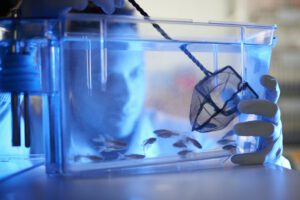
Neck and back pain could be caused by changes in gene activity that trigger the breakdown of the spine’s natural shock absorbers, according to researchers in the U.K. Findings from a study in zebrafish, titled “Targeted modulation of phosphate and lipid metabolism reduces ligament mineralization in col9a1b deficient zebrafish,” and published in Communications Biology, suggest that changes in gene activity can lead to a build-up of minerals in the spine—similar to unwanted bone forming in the wrong place—causing it to harden.
Experts say the findings point to potential future drug targets to treat back pain and suggest zebrafish could be a valuable tool for testing them.
Back pain affects most people at some point in their lives. One of the main underlying causes is the gradual breakdown of spinal discs (which cushion the bones of the spine), known as intervertebral disc degeneration (IVDD).
Despite how common and costly IVDD is, there are currently no drugs that can stop or reverse the condition. Surgery remains the only long-term option.
Genetics are known to play a role in the development of IVDD. A gene connected to a protein called collagen IX, which helps hold the disc’s structural fibers together, has been repeatedly linked to early-onset disc problems.
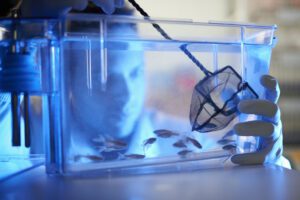
Scientists from the Universities of Edinburgh and Bristol studied zebrafish that were bred to lack a working copy of the gene to better understand how genetic faults could lead to disc disease. As the fish aged, their spines developed problems strikingly similar to human disc disease. The bones of the spine fused together, and the tissue between vertebrae became abnormally hardened with mineral deposits.
The team found that this hardening was preceded by a breakdown in a supportive scaffold layer in the developing spine, well before any mineral began to build up.
Researchers looked at which genes were switched on or off in the fish. They uncovered disruptions to how the body handles fat and to a growth-control pathway called mTOR, alongside changes in phosphate handling and vitamin A signaling, all processes linked to mineral buildup.

The team was also able to demonstrate ways to reduce the damage. The bone-protecting drug bisphosphonate, which is already used for osteoporosis, blocked the mineral buildup. Simply restricting the fish’s food intake, or using drugs that dampen fat metabolism, also reduced spinal fusions.
The findings point to phosphate handling and fat metabolism as promising targets for future drugs, according to the research team.
“For decades, surgery has been the only real answer for disc disease. By understanding the biology that drives the spine to harden, our zebrafish studies point to several ways of slowing it down, including a drug already used safely in patients,” said Erika Kague, PhD, study lead from the University of Edinburgh’s Institute of Genetics and Cancer. “There’s more work to do, but for a condition that’s affected people for generations without a treatment in sight, this is super exciting.”
“For the 9.5 million people across the U.K. living with back pain, this research brings fresh hope that potential new therapeutic approaches are on the horizon,” added Caroline Aylott, PhD, head of research delivery at Arthritis UK. “We are proud to fund research that is unlocking the science behind the processes leading to spinal disc degeneration. Back pain is one of the U.K.’s most common conditions that has blighted millions over generations.
“Dr. Erika Kague and her team at the University of Edinburgh have uncovered important genetic evidence that could pave the way for new treatments, bringing us one step closer to a future where fewer people have to live with the daily pain and challenges that back pain can bring.”
The post Genetic Findings Provide Insights Into Leading Cause of Back Pain appeared first on GEN – Genetic Engineering and Biotechnology News.


Illinois’ financial crisis could bring the state to a halt
The final 6 ‘Game of Thrones’ episodes might feel like a full season
New Season 8 Walking Dead trailer flashes forward in time
Mod turns ‘Counter-Strike’ into a ‘Tekken’ clone with fighting chickens
Meet Superman’s grandfather in new trailer for Krypton
Disney’s live-action Aladdin finally finds its stars

Opinion: AI won’t enhance physician autonomy. It will further diminish it
FMT Shows Promise for Peanut Allergy Tolerance in Phase I Trial

Genetic Findings Provide Insights Into Leading Cause of Back Pain

Replimune rebounds to win FDA approval of melanoma drug
Engineered Human Interneuron Transplants Repair Respiratory Circuits in Injured Rats
Third time’s the charm for Replimune as melanoma drug earns FDA greenlight
Illinois’ financial crisis could bring the state to a halt
The final 6 ‘Game of Thrones’ episodes might feel like a full season
New Season 8 Walking Dead trailer flashes forward in time
Mod turns ‘Counter-Strike’ into a ‘Tekken’ clone with fighting chickens
Meet Superman’s grandfather in new trailer for Krypton
Disney’s live-action Aladdin finally finds its stars
-
Fierce Biotech4 months ago
Scientists turn pig semen extract into eye drops that kill cancer in mice
-
 Uncategorized9 years ago
These ’90s fashion trends are making a comeback in 2017
-
Endpoints News5 months ago
Novartis to pay $2B upfront to take next-gen PI3Kα inhibitor from Synnovation
-

 Uncategorized5 months ago
Novartis buys Synnovation’s PI3Kα inhibitors for $3 billion
-
Uncategorized9 years ago
According to Dior Couture, this taboo fashion accessory is back
-
Uncategorized9 years ago
Steph Curry finally got the contract he deserves from the Warriors
-
Uncategorized9 years ago
Phillies’ Aaron Altherr makes mind-boggling barehanded play
-
Uncategorized9 years ago
Uber and Lyft are finally available in all of New York State