
Uncategorized
Expanding the Toolbox for Mammalian Genome Engineering


Sponsored content brought to you by

Across biomanufacturing, disease modeling, synthetic biology, and cell therapy development, researchers increasingly need to insert large DNA constructs into mammalian genomes. Yet despite significant advances in genome editing technologies over the past decade, integrating large DNA payloads into mammalian genomes efficiently, site-specifically, and safely has remained a challenge.
Cell line developers are engineering bigger
For cell therapy applications, simple chimeric antigen receptor (CAR) designs are no longer sufficient. Next-generation constructs incorporate logic gating, safety switches, multiple signaling domains, and regulatory elements. At the same time, many therapeutic strategies require expression of full-length genes to address loss-of-function mutations—no small task, given that the median human gene length is 24–27 kb.
This challenge extends to biomanufacturing and synthetic biology, where multi-gene constructs and synthetic promoters lead to large expression cassettes.1,2
Why conventional knock-in approaches struggle
Most targeted genome editing strategies rely on homology-directed repair (HDR) following a CRISPR-induced DNA double-strand break. While this method works well for small edits, there is a risk of off-target events. In addition, low efficiency makes it difficult to generate inserts greater than 3–5 kb and, since HDR requires an active cell cycle and DNA repair, this method is not usable for non-dividing cells.
Random integration approaches, including lentiviral vectors and transposon systems, can improve insertion efficiency but at the cost of control. DNA integrates at unpredictable genomic locations, often resulting in multiple copies and highly variable expression, which extends timelines by requiring clone screening and selection.
Large serine recombinases provide a partial solution
Large serine recombinases enable efficient, site-specific integration of large DNA payloads without relying on cellular repair pathways. With optimization, these systems can accommodate multi-gene constructs and full-length genes with high efficiency.3
However, integration site still matters. Without a defined genomic target, expression of inserted constructs can vary due to chromatin context, leading to inconsistent performance across clones.

Targeted large knock-ins with TARGATT technology
TARGATT technology addresses the large knock-in challenge by combining efficient, site-specific integration using a large serine recombinase with a validated genomic target site.
In this approach, a TARGATT landing pad is established at the H11 safe harbor locus, enabling precise insertion of large DNA constructs into a location that supports robust, stable, and uniform gene expression. By directing integration to this single, well-characterized site, TARGATT technology enables consistent expression within cell populations—streamlining cell line development for biomanufacturing and therapeutic applications.
This strategy provides several key advantages:
- Efficient integration of large DNA payloads, including multi-gene constructs and multiple expression cassettes4
- Targeted insertion at the H11 safe harbor locus
- Single-copy, defined genomic integration
- Reduced clonal variability and screening burden
- Enables pool-based screening
- Reproducible expression across engineered cell lines
Because each construct is inserted into the same genomic location, developers can generate cell lines with greater predictability significantly reducing the time and effort required for clone screening and selection.
Toward more predictable cell engineering
From advanced CAR-T designs to multi-gene therapeutic constructs and synthetic biology circuits, many next-generation applications depend on stable integration of large genetic payloads.
By pairing efficient large DNA integration with the proven H11 safe harbor locus, TARGATT technology enables a more controlled and reproducible approach to mammalian cell engineering—helping researchers move beyond the traditional limitations of large knock-ins.
References
1. Joshua Mayne, et al. Billion-Scale Deciphering of Human Gene Regulatory Grammar. BioRxiv 2025.11.10.687627.
2. Leonid Gaidukov, et al. A multi-landing pad DNA integration platform for mammalian cell engineering. Nucleic Acids Res. 2018 May 4;46(8):4072-4086. doi: 10.1093/nar/gky216.
3. W. Marshal Stark. Making serine integrases work for us. Curr Opin Microbiol. 2017 Aug:38:130-136. doi: 10.1016/j.mib.2017.04.006.
4. Applied StemCell. Expanding the capabilities of targeted integration. Published December 18, 2025.

See how TARGATT technology can help you engineer bigger by visiting appliedstemcell.com/targatt-technology.
The post Expanding the Toolbox for Mammalian Genome Engineering appeared first on GEN – Genetic Engineering and Biotechnology News.

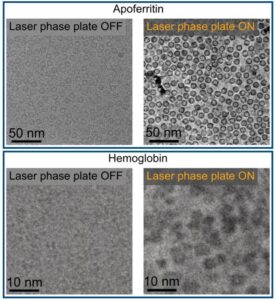
You know when you are at the eye doctor getting an updated prescription, and suddenly the world snaps into sharper focus? Physicists at the University of California (UC), Berkeley, have now done something similar for electron microscopy. By introducing phase contrast into a cryo‑electron microscope, they have delivered dramatically sharper images of some of biology’s smallest and most elusive proteins.
The advance comes from a new laser phase plate (LPP), described in the paper “Laser phase plate improves structure determination of small proteins by cryo‑EM,” which was published recently in Science. Led by physicist Holger Mueller, PhD, of UC Berkeley and Lawrence Berkeley National Laboratory, the team demonstrated that a laser‑driven phase plate can overcome one of cryo‑EM’s most persistent limitations: poor contrast for small proteins.
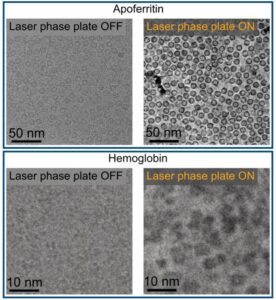
Cryo‑EM has transformed structural biology over the past decade, earning a Nobel Prize in 2017 for enabling high‑resolution structures without crystallization. But despite its impact, the technique still struggles with proteins below ~70 kilodaltons—a size range that includes about 90% of the human proteome. “Because of signal-to-noise limitations, the majority of human and animal proteins are too small to be analyzed by these methods [cryo-EM and cryoelectron tomography]. The increase in signal-to-noise ratio provided by this laser phase plate is expected to overcome these important limitations.”
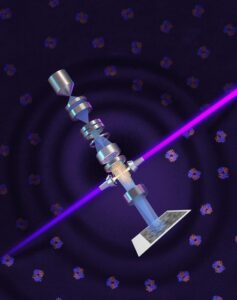
The new LPP begins to address that problem. The LPP uses an intense, continuous‑wave laser to shift the phase of the electron beam itself. This produces true phase contrast without dimming or destabilizing the beam. Mueller described the laser focus as “75 kilowatts focused to a few microns… That’s more powerful than what you use for welding. It has more power than a military laser. It builds up the brightest continuous laser focus ever.”
Installed in a custom Thermo Fisher Titan Krios, the LPP immediately improved the clarity and resolvability of small proteins, including hemoglobin, which sits at the lower limit of what today’s cryo‑EM instruments can handle. As the authors wrote in the abstract: “Here, we show that the laser phase plate (LPP)… enhances the resolution in single-particle reconstruction of small proteins by improving specimen-motion correction, recovery of information from the early frames, as well as particle visualization, 3D classification, and alignment.”
These improvements were achieved using standard defocus ranges and reconstruction workflows. “For the most challenging cases—small particles, bad specimens—the laser produces a very considerable advantage,” Mueller said.
The impact extends beyond single‑particle analysis. Cryo‑electron tomography (cryo‑ET), which assembles multiple angular views of a molecule or protein into a three-dimensional image, stands to benefit even more. “With cryo-ET, we’re looking at small, very complicated cellular material that’s incredibly crowded inside the cell,” said Bridget Carragher, PhD, founding technical director of imaging at Biohub. “It’s like a forest of trees, and you’re trying to find one leaf on one tree in there. Cryo-ET needs a dramatic step forward in contrast, so we can start to see what’s going on inside the cell. That’s what the laser phase plate promises to give us.”
Biohub is developing a dual‑laser version of the system, designed to reduce component wear and minimize aberrations. Meanwhile, Mueller’s team is pushing toward imaging proteins as small as 17 kilodaltons, a threshold that would open access to vast regions of the human proteome previously invisible to cryo‑EM.
“This technology is a step function change for biology,” said Stephani Otte, PhD, Biohub’s vice president of imaging science. “What was once invisible will become visible—and that changes everything about how we understand disease.”
“The bottom line is, if you have a large protein and a really good sample—a fresh one or one frozen without bubbles, for example—you may not need the phase plate to get a single, high-quality image. But for a small protein and a bad sample, laser-on is best,” Mueller said. “This could fill an enormous gap in our knowledge of protein structures that can’t be crystallized or are too small for today’s cryo-EM. And it will be revolutionary for cryo-ET.”
The post Laser‑Driven Phase Contrast Enhances Cryo‑EM Resolution of Small Proteins appeared first on GEN – Genetic Engineering and Biotechnology News.
Uncategorized
STAT+: Updated: Tracking RFK Jr.’s promises to remake health in America
Updated June 11, 2026
WASHINGTON — A pledge to “Make America Healthy Again” earned Robert F. Kennedy Jr. his job atop U.S. health agencies a year and some change ago. He’s now had the opportunity to turn his words into action, with mixed results.
“All one needs” to prove the health secretary’s attentiveness is to “review my unprecedented list of accomplishments on a wide range of issues, all of which I drove,” Kennedy posted on X on Wednesday in response to a journalist.

Updated June 11, 2026
WASHINGTON — A pledge to “Make America Healthy Again” earned Robert F. Kennedy Jr. his job atop U.S. health agencies a year and some change ago. He’s now had the opportunity to turn his words into action, with mixed results.
“All one needs” to prove the health secretary’s attentiveness is to “review my unprecedented list of accomplishments on a wide range of issues, all of which I drove,” Kennedy posted on X on Wednesday in response to a journalist.

Can any of the new obesity medications in development stand out from the pack? Which company just broke records with its IPO? And will the Food and Drug Administration allow greater access to experimental peptides?
We discuss all that and more on this week’s episode of “The Readout LOUD,” STAT’s biotech podcast.


Illinois’ financial crisis could bring the state to a halt
The final 6 ‘Game of Thrones’ episodes might feel like a full season
New Season 8 Walking Dead trailer flashes forward in time
Mod turns ‘Counter-Strike’ into a ‘Tekken’ clone with fighting chickens
Meet Superman’s grandfather in new trailer for Krypton
Disney’s live-action Aladdin finally finds its stars

Laser‑Driven Phase Contrast Enhances Cryo‑EM Resolution of Small Proteins

STAT+: Updated: Tracking RFK Jr.’s promises to remake health in America

An obesity drug deep-dive, and peptides move mainstream

RFK Jr. claims his calendar is publicly available. We’ve been trying to get it for a year

Nonprofit buys experimental cancer drug to maintain patient access
Potential Cocaine Addiction Targets Identified Through Genetic Mapping in Rats
Illinois’ financial crisis could bring the state to a halt
The final 6 ‘Game of Thrones’ episodes might feel like a full season
New Season 8 Walking Dead trailer flashes forward in time
Mod turns ‘Counter-Strike’ into a ‘Tekken’ clone with fighting chickens
Meet Superman’s grandfather in new trailer for Krypton
Disney’s live-action Aladdin finally finds its stars
-
 Uncategorized9 years ago
These ’90s fashion trends are making a comeback in 2017
-
Uncategorized9 years ago
According to Dior Couture, this taboo fashion accessory is back
-
Endpoints News3 months ago
Novartis to pay $2B upfront to take next-gen PI3Kα inhibitor from Synnovation
-
Uncategorized9 years ago
Phillies’ Aaron Altherr makes mind-boggling barehanded play
-
Uncategorized9 years ago
Uber and Lyft are finally available in all of New York State
-
Contributors9 years ago
The final 6 ‘Game of Thrones’ episodes might feel like a full season
-
Uncategorized9 years ago
Steph Curry finally got the contract he deserves from the Warriors
-
Uncategorized9 years ago
The old and New Edition cast comes together to perform