
Uncategorized
“Click Clotting” Technique Rapidly Creates Stronger Blood Clots

Researchers at McGill University have developed a rapid way to engineer blood clots that stop severe bleeding and support tissue healing more effectively. Their technique, called “click clotting,” links red blood cell surface proteins through a chemical reaction, resulting in a biocompatible clot that is 13 times more resistant to fracturing and four times more adhesive than natural blood clots. The team said the method could be used to develop life-saving biomaterials to help control severe bleeding, as well as benefit people with clotting disorders.
“Natural blood clots can be slow to form and mechanically fragile, which limits their ability to stop severe bleeding and can compromise healing,” said Jianyu Li, PhD, senior author and professor of mechanical engineering and Canada research chair in tissue repair and regeneration. “Our work shows that, when engineered appropriately, red blood cells can play a central structural role, enabling the design of stronger and more functional biomaterials.”
Senior and corresponding author Li, together with first author Shuaibing Jiang, PhD, reported on the development in Nature, in a paper titled “Engineering tough blood clots for rapid hemostasis and enhanced regeneration.” In their paper the team concluded, “Our strategy enables instantaneous clotting and markedly enhanced fracture resistance despite low structural polymer content, while preserving the intrinsic bioactivity of blood clots to enhance hemostasis and regeneration.”
Jiang, now a postdoctoral associate at Harvard Medical School, led the research during his PhD studies at McGill. Researchers at the University of British Columbia, the Medical College of Wisconsin, the University of Colorado Boulder, the University of Toronto and the research institute Versiti also contributed.
“Blood clots are pivotal for hemostasis and regeneration, but they are mechanically weak and form slowly, posing risks for life-threatening hemorrhage and limiting broader applications,” the authors wrote. “These limitations are attributed to complex coagulation cascades, abundant mechanically ineffective cells, and little structural polymers.”
Previous efforts to crosslink red blood cells (RBCs) have used chitosan, a polymer derived from crustacean shells, but these led to brittle clots, ruptured cells, and inconsistent clotting. In “click clotting,” the clot structure is fundamentally strengthened through a fast, bio-safe chemical reaction that connects proteins on the red blood cell surface, forming a solid gel in just five seconds. Because the “click” reaction doesn’t interfere with normal blood chemistry, it can work alongside the body’s natural clotting process. As a result, the artificial cell‑based gel, called a “cytogel,” can be added to whole blood, where it becomes embedded within the body’s own fibrin clot.
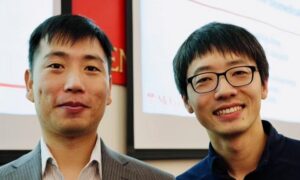
![Shuaibing Jiang (left) and Jianyu Li [Jianyu Li]](https://www.genengnews.com/wp-content/uploads/2026/04/Low-Res_16x9-Shuaibing-Jiang-and-JianyuLi-300x180.jpeg)
“Here we report a strategy that rapidly crosslinks red blood cells into tough cytogels and integrates them within blood clots,” the team further explained. “The resulting engineered blood clots (EBCs) form within seconds and exhibit a 13-fold increase in fracture toughness, and a 4-fold improvement in adhesion energy compared with native clots … Our strategy is advantageous over previously reported methods using chitosan to crosslink RBCs, which lead to brittle clots, hemolysis or inconsistent clotting.”
Li added, “The technology enables both autologous clots (using the patient’s own blood) and allogeneic clots (using type-matched donor blood). Autologous clots can be prepared in approximately 20 minutes, while allogeneic clots can be prepared within about 10 minutes. Given typical clinical time constraints, this approach has strong potential for in-patient emergency care, wound management and related settings.”
The team confirmed their results through in vitro testing, as well as through tests in rodents. “In vivo studies demonstrate that EBCs can rapidly halt hemorrhage, promote tissue regeneration, mitigate inflammation and foreign body reactions, and prevent postoperative adhesion,” the authors stated. Of particular note was effective healing and regeneration observed in the injured liver, with performance exceeding that of a clinically used product tested also tested as part of the study. “Compared with previously reported biomaterials for liver regeneration, EBC demonstrated milder inflammation and more efficient tissue regeneration,” the authors noted. Analyses showed minimal evidence of immune reactivity and no toxicity in major organs.
The researchers say that while further study is required before the cytogel can be used in clinical settings, the research establishes a foundation for its design and application. “Overall, EBC, as a native scaffolding material, can promote tissue regeneration with minimal inflammation and foreign body responses, and prevent postoperative adhesions, outperforming the clinically used products,” the scientists concluded. “This work may motivate the development and translation of highly cellularized materials for bleeding control, wound management, tissue repair and regenerative medicine.”
“Engineered blood clots have strong potential for broad clinical use and could improve outcomes across many medical situations,” Li said.
The post “Click Clotting” Technique Rapidly Creates Stronger Blood Clots appeared first on GEN – Genetic Engineering and Biotechnology News.

In a study published in Cell titled, “Deep learning of functional perturbations from condensate morphology,” researchers at Princeton University have applied AI to understand how drugs affect the dynamics of key structures within the cell. The work introduces a tool that can map morphology to functional outcomes and shed light on markers of health.
The authors examined the changes in shape of biomolecular condensates, tiny droplets in cells that drive transcription and other gene regulation processes linked to disease, including Alzheimer’s, ALS and cancer. The findings support a robust system for monitoring and evaluating cellular responses to drugs at a single-cell level.
“The central problem in biology is how do you get emergent structure from individual molecular interactions,” said Cliff Brangwynne, PhD, professor of chemical and biological engineering at Princeton and corresponding author of the study. “The key innovation here was to develop a way to learn from the images and classify the patterns that are emergent.”
The team used an advanced microscope to image nucleolar morphology changes in hundreds of human cells under a range of drug-controlled conditions. Machine learning tools sorted the images into four basic categories based on the shape of the nucleolus, uncovering “cap” and “necklace” shapes linked to cellular stress responses.
The authors ran a panel of drugs to examine the effect on nucleolar formation and measured changes in the condensate’s development. Varying concentrations caused different degrees of change in both caps and necklaces.
Two known anti-cancer drugs caused caps, while a third drug, called topotecan, triggered a new nucleolus morphology that the researchers labeled “flower.” While topotecan inhibits TOP1, an key enzyme during DNA replication, loss of TOP1 induced the flower shape and uncovered the enzyme’s role in maintaining nucleolar organization by regulating RNA processing.
“No one’s seen this flower morphology before,” said Brangwynne. “The network flagged it as not fitting neatly into the other three categories.”
The team also tested their neural network on other condensates related to RNA processes, observing similar dose-and-response results for drugs specific to nuclear speckles, a hub for messenger RNA activity, and condensates from respiratory syncytial virus.
This finding underscores the value of analyzing morphological changes. “You could be missing other important features,” said Anita Donlic, PhD, postdoctoral researcher and first author of the study. “Things that could tell you there’s new biology.”
The post AI Predicts Gene Regulation for Drug Discovery Using Condensate Morphology appeared first on GEN – Genetic Engineering and Biotechnology News.
Elicio Therapeutics’ investigational cancer immunotherapy failed to meet the primary endpoint of disease-free survival in a Phase 2 trial—a result the company attributed mostly to a disproportionate number of patients with higher residual disease.
Uncategorized
STAT+: Lilly’s Ajax acquisition may have been worth it
Want to stay on top of the science and politics driving biotech today? Sign up to get our biotech newsletter in your inbox.
A worsening shortage of Bicillin, Pfizer’s injectable form of penicillin, left an Arizona woman unable to receive timely treatment for syphilis during pregnancy.
Also, the FDA approved Sanofi’s diabetes drug Tzield after an unusually contentious review process, and the Trump administration has proposed closing a Medicare negotiation loophole.

Want to stay on top of the science and politics driving biotech today? Sign up to get our biotech newsletter in your inbox.
A worsening shortage of Bicillin, Pfizer’s injectable form of penicillin, left an Arizona woman unable to receive timely treatment for syphilis during pregnancy.
Also, the FDA approved Sanofi’s diabetes drug Tzield after an unusually contentious review process, and the Trump administration has proposed closing a Medicare negotiation loophole.


Illinois’ financial crisis could bring the state to a halt
The final 6 ‘Game of Thrones’ episodes might feel like a full season
New Season 8 Walking Dead trailer flashes forward in time
Mod turns ‘Counter-Strike’ into a ‘Tekken’ clone with fighting chickens
Meet Superman’s grandfather in new trailer for Krypton
Disney’s live-action Aladdin finally finds its stars
AI Predicts Gene Regulation for Drug Discovery Using Condensate Morphology
Elicio crashes on midstage pancreatic cancer miss but will advance to Phase 3

STAT+: Lilly’s Ajax acquisition may have been worth it

STAT+: Pharmalittle: We’re reading about Pfizer’s emergency penicillin program, a Sanofi diabetes drug, and more

STAT+: Where ‘democracy met science,’ 50 years ago
Sanofi wins type 1 diabetes nod for Tzield after requesting to revoke CNPV
Illinois’ financial crisis could bring the state to a halt
The final 6 ‘Game of Thrones’ episodes might feel like a full season
New Season 8 Walking Dead trailer flashes forward in time
Mod turns ‘Counter-Strike’ into a ‘Tekken’ clone with fighting chickens
Meet Superman’s grandfather in new trailer for Krypton
Disney’s live-action Aladdin finally finds its stars
-
 Uncategorized9 years ago
These ’90s fashion trends are making a comeback in 2017
-
Uncategorized9 years ago
According to Dior Couture, this taboo fashion accessory is back
-
Endpoints News3 months ago
Novartis to pay $2B upfront to take next-gen PI3Kα inhibitor from Synnovation
-
Uncategorized9 years ago
Phillies’ Aaron Altherr makes mind-boggling barehanded play
-
Uncategorized9 years ago
Uber and Lyft are finally available in all of New York State
-
Contributors9 years ago
The final 6 ‘Game of Thrones’ episodes might feel like a full season
-
Uncategorized9 years ago
Steph Curry finally got the contract he deserves from the Warriors
-
Uncategorized9 years ago
The old and New Edition cast comes together to perform